Tuesday, January 31, 2017

On Bogus Progressives

Does anyone actually think Nicholas Kristof is a progressive of any sort?

Somebody writing in the New Republic does - ironically in an article criticizing Kristof’s repeated efforts to legitimize a favorite conservative canard. The piece is entitled The Myth of the Liberal ‘Echo Chamber' on Campus.” Of course, Kristof's tired talk of a liberal echo chamber" comes straight out of the conservative echo chamber. It's the right’s standard lament about liberal intolerance" in academia but with the surprise twist that it is delivered by a liberal." (It isn't.)

Such an absurd turd needs constant polishing and Nicholas Kristof’s practiced hand-wringing is equal to the task. He has written several pieces pushing this stupid thesis. I will explain why it’s stupid in this footnote(1) but my point here is somebody actually called Kristof a progressive." Granted, that is what he calls himself - I’m just stunned that someone is humoring him. (Not really.)

Seriously, Kristof routinely scolds the poor. He circulates conservative urban legends about rampant cheats on disability. He bashes teachers unions. And he simply adores sweatshops - he just loves them. They are one of his favorite things - that and decrying intolerant" progressives, apparently. In the first article, he makes the requisite acknowledgements that their working conditions are appalling, but his enthusiasm builds across time. By the second article, he says clothing labels should proudly boast that they are made in sweatshops. 

If the absurdity of his Orwellian position escapes you, let me explain: Progressives have historically opposed sweatshops. It was a focus of their reform efforts at the turn of the last century - and the one before that. Tragedies like the 1911 Triangle Shirtwaist Fire repeat themselves in Bangladeshi garment factories. Like in the Triangle Fire, the women workers were locked in the building during their shift and many eventually  jumped to their deaths attempting to escape flames and suffocation. In 1911, the horror shocked America's conscience into action. Today, good liberals" ignore such troubling thoughts, lest they feel bad about their last thousand purchases.(2)

Of course, 1911 had its Nicolas Kristofs to do damage-control too. See also antebellum pro-slavery propaganda. The eternal narrative is These people never had it so good and are/should be grateful."


The point is progressives do not whitewash sweatshops. Period. Call me an impossible-to-please purist," but that's a pretty definitional baseline thing, both past and present. In fact, it is foundational because it was a major focus in the movement's early history. By way of analogy, if somebody said they were a feminist" but then suggested women should not be allowed to vote, it would not be purist to call out such manifest bullshit - it would just be voicing common sense.


Nicholas Kristof had also praised welfare reform. Yes, he later admitted he was wrong on that, but his apologia was not entirely awesome. And how genuine is his contrition if he continues to parrot conservative talking points afterwards?

If his soul-searching is actual rather than affectation, he should revisit his other opinions because his whole career seems to consist of oily moralizing and concern trollingThis is painful for a liberal to admit but conservatives have a point when they suggest that America’s safety net can sometimes entangle people in a soul-crushing dependency.” Such lines are his stock-in-trade. Nicholas Kristof is pretty much John Stossel minus the porn mustache. Most of these shills are.

Well, okay, Thomas Friedman has the porn mustache too.


Such pundits are not progressives or even liberals. They exist to make right-wing schemes and fever dreams seem reasonable and innovative to liberal readers. They cynically prey upon liberals’ famous open-mindedness to promote unconscionable policies.

It’s a pretty shitty literary industry. Do you want to be a published pundit? Then comfort the comfortable, afflict the afflicted, and guy the gullible. Tisking is uplift and you can say the most grotesquely reactionary things so long and you insist you are a sensible” Democrat and don’t sound quite as paternalistically racist as, say, Rudyard Kipling. 

Obviously, Nicolas Kristof is not the only Potemkin progressive pontificating out there. Since the last Democratic primary, pretending to be a progressive has become quite fashionable - particularly among centrists bashing actual progressives. Pseudo-progressives are everywhere saying all sorts of shockingly ignorant and incongruous things on Twitter and other social networking sites. (3) They sound like conservatives do when mis-invoking Martin Luther King - which I suppose is appropriate when you remember what King thought about  white moderates.(4)

But such posturing is actually nothing new. Indeed, it is literally old news. Fairness and Accuracy In Reporting (FAIR) is a progressive watchdog organization has been monitoring the corporate media since 1986. (No doubt you've noticed that I've linked to them a lot.) They have repeatedly revealed that the acceptable spectrum of opinion on American television goes from the center to the far right. Fascists like Pat Buchanan were routinely piped into our living rooms: Leftist academics like Howard Zinn not quite so often. Alas, print isn't much better. The corporate media has been paving the way for Donald Trump for some time.

Of course, if you are going push the Overton Window to the right you cannot announce it. That would defeat the purpose. So you have centrists pretend to be progressives. In 1990, four years after its founding, FAIR exposed several
 phony television progressives. In 1998, they once again complied a field guide of these counterfeit leftists.  And in 2004, they discovered nothing had changed: actual progressives were absent as usual. And so it goes.

This is how the establishment press operates. Surprise! It caters to the establishment. As I keep saying, the mainstream media is composed of enormous corporations that make their revenue almost entirely by selling advertising to other enormous corporations.  You don't need a conspiracy theory to explain this: It's just business. The Invisible Hand of Self-Interest isn't particularly invisible here. 

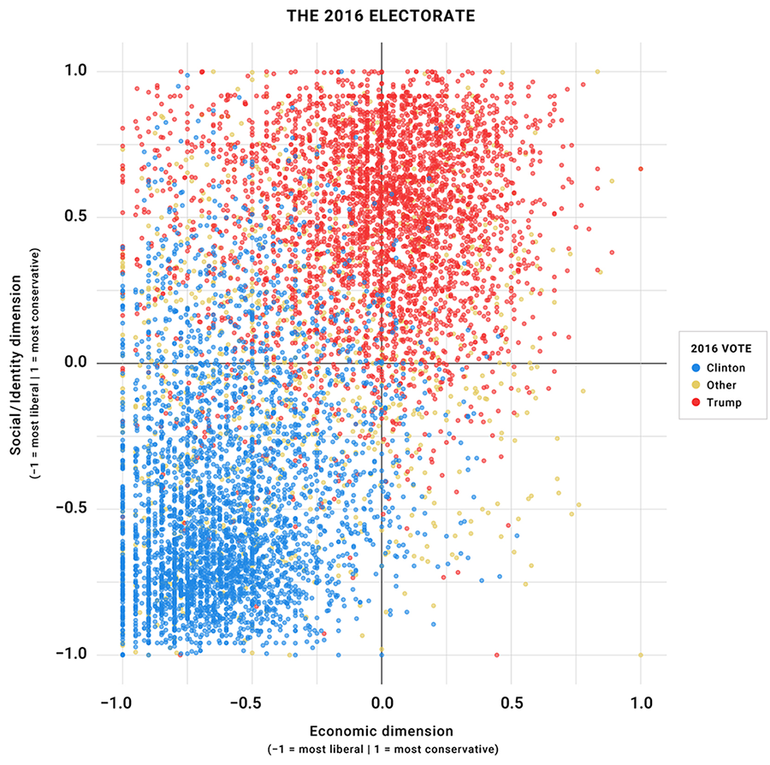
But what might be surprising to some is the fact that centrism is profoundly unpopular with most voters - but it is spectacularly attractive to advertisers so pundits must sell it to us relentlessly. If you need to visualize just how unpopular centrists are, this chart is most helpful.   


The lower righthand quadrant are voters who identify as “socially liberal, but fiscally conservative," i.e. libertarians and centrists. But even when combined together, they only compose a small portion of the electorate. If this was an aerial crowd photo, we'd wonder if they all had horrible body odor.

To put it another way, think of all those round table discussions on reproductive freedom or women’s rights where all the speakers are men. They are monstrous and absurd. But they are not unlike every discussion we have on class or the economy: Only rich people are invited to opine. 


EDIT:

This became a two-parter because you cannot bash sweatshop apologists enough. Part two is here.

___________

1) Broadly speaking, there are basically two kinds of conservatives: economic and cultural - and an increasing number of them are both. Likewise, academia roughly breaks down to the humanities and the sciences. Kristof concedes that many economic conservatives may prefer the private sector to academia because it is more lucrative. No shit. If you want to get rich, you are probably not going to major in philosophy or art history. As for the hard sciences, if you are a conservative geologist, you would certainly prefer to find new oil fields for Exxon than teach rocks for jocks" at a local college - ditto with chemistry, biology, etc. But cultural conservatives self-select themselves out of academia too because they are inherently hostile to the subject matter. Think of the humanities: There is the nude in art, gay writers, philosophers questioning the existence of God, etc. And forget the sciences because biology teaches evolution and geology teaches that the earth is millions of years old. Never mind global warming, the scientific method, and critical thinking skills as a whole. Unless whole subject matters are gutted of core content, most conservatives are going to feel uncomfortable in academia. Some might feel fine, but not the bulk of them.

2) Full Disclosure: Although I try to buy at least American made - if not union made - it is next door to impossible to not own some sweatshop-produced product. It sucks. But Kristof thinks it doesn't. This site has a mix of union and American made merchandise.

3) It's gotten too easy to flush-out frauds and I'm getting bored. So, here's a few pro tips to help the phonies out there improve their game and making things more interesting.

First, actual progressives are alarmed about economic inequality. Historically, we always have been, so we are sort of invested in it. Therefore, trivializing it may impact your credibility. 

Also, try to avoid pitting it in a false trade-off against race or sex because we progressives are pretty big into intersectionality and if you don’t know what that is it will show. Moreover, posing false trade-offs is a favorite conservative tactic (liberty vs. equality, jobs vs. the environment, etc.) and you don't want to blow your cover right away.

Second, we progressives generally consider ourselves on the left, so spouting Horseshoe Theory is not something any leftist would logically be inclined to do since we are loathe to associate with the right and highly unlikely to conflate the two. It’s a conspicuously centrist conceit and thus a great way to accidentally out yourself. Not to mention the fact that, if you are pretending to be a progressive while you are invoking that horseshoe horseshit, you are equating yourself with the far right. And lest you think moderation prevents moving too far along the arc, remember that Donald Trump is a textbook ideological moderate. Do not confuse the temperament with the ideology.

Moreover, I should also mention that conflating right and left is exactly what reactionary cranks like Glenn Beck and Jonah Goldberg do when they call progressives fascists." And that is not a good look on you or anyone else. I have written about this a bit previously.

Finally, when you say the left is a greater threat than the right, you have shown your true colors. Give up, go home, and find some honest occupation that does not entail slandering good people. It’s not the shooting star you really want to hitch your wagon to.

4) There’s a Facebook meme in which someone says she is thinking of naming her cats Thoughts and Prayers because they are useless.” I might name my next cat White Moderate.

Wednesday, January 4, 2017

It's Both, Stupid

When Bill Clinton first ran for president in 1992, there was a sign on his Little Rock, Arkansas campaign headquarters wall that read, "It's the economy, stupid."(1) It was a brief and blunt reminder to relentlessly hammer George Bush Sr. with this significant - and then signature - issue.(2)

Well, good luck getting many Clintonistsas or establishment pundits to admit that the economy impacts voter behavior today. The middle class has been shrinking and the wealth gap has been widening, but many busy wordsmiths hold the passionate conviction that voters are totally okay with that. According to their anything-but-the-economy arguments, nobody votes their pocketbook anymore and only spoiled college boys care about factory closings or job layoffs. Their breathless lectures on privilege and realism displayed zero self-awareness. They would be hilarious if they did not have such catastrophic consequences.

I am not arguing that racism and sexism were not factors in the outcome of this election – on the contrary, they were profoundly important – but class was a massive factor as well, and these writers don't seem to see wealth as a form of privilege. They are, at best, oblivious to the possibility that it might be, and at worst, in militant denial that it is. They can't imagine that it matters to anyone because it doesn't matter to them. And that, of course, is the very definition of privilege. So, small wonder they cannot possibly fathom how race and class interact. Indeed, they see the two as mutually-exclusive.

For example, take this little gem purporting to prove that economics had nothing to do with Trump's win because - drum-roll, please - his supporters are split on the issue of trade.

No shit. Both parties are. Republicans were practically the exclusive party of "free trade" until Bill Clinton passed NAFTA. It's a pretty libertarian pro-business position, so OF COURSE a huge hunk of Republicans still favor free trade. Trump just used anti-NAFTA rhetoric to peel away enough blue collar votes to swing the Rust Belt.

This could have alienated traditional white collar conservatives, but it didn’t. They correctly reasoned, "Trump doesn't really mean it: He's a businessman. He makes most of his merchandise in China." Conversely, many working class voters disastrously rationalized that Trump did not really mean his racist rhetoric, but hoped against hope that he might move the needle on trade and voted accordingly. In short, most of the people who voted for Trump did so because they thought he was lying.(3) Some did from a position of affluence and strength and others did from a position of desperation after decades of declining fortunes. Watch both videos. They are heart-rending.

So white collar conservatives accordingly stayed put instead of bolting across the aisle into Hillary Clinton's camp. Apparently, all those establishment GOP endorsements she chased down had no benefit. Indeed, in this anti-establishment climate, they were a definite detriment with many voters in both parties. Moderate Republicans were supposed to flock to her banner in the spirit of sensible bipartisanship. Of course, that did not happen.(4)

What accounts for the confusion of that article’s author? Best guess says abysmal historical illiteracy and going by Trump's statements in that vacuum. Not only was the GOP's pro-business proclivities unknown to her, she was apparently unaware that working class whites do not have a monopoly on racism. Indeed, racism has been driving suburban growth since the Fifties. White flight has long been monetized and politicized – frequently violently. The suburbs are not quite bucolic bastions of liberal enlightenment.

This impacts trade politics. Remember Rush Limbaugh’s racist defense of NAFTA:
If you are unskilled and uneducated, your job is going south. Skilled workers, educated people are going to do fine 'cause those are the kinds of jobs NAFTA is going to create. If we are going to start rewarding no skills and stupid people, I'm serious, let the unskilled jobs that take absolutely no knowledge whatsoever to do - let stupid and unskilled Mexicans do that work.
The suburbs are filled with people who think like this; which is why those so-called soccer moms who were supposed to break for Clinton stayed with Trump instead. These people hate unions, go to high-tech suburban mega-churches, and love the fact that they can buy stuff at Walmart for next to nothing because that's what the people who make it are paid. These Paula Deen-like ladies would love to have their own slaves. Alas, "political correctness" and the Thirteenth Amendment prevent that.

And lest this salient facet escape your attention: Rush Limbaugh was not siding with Bill Clinton - Bill Clinton was siding with Republicans (who Rush Limbaugh spoke for). George Bush Sr. had negotiated NAFTA, but Bill Clinton fought his own party to secure passage.(5) The Clinton Administration went so far as to have Al Gore debate Ross Perot about it. Overt support doesn't get much more theatrical than that. That’s the problem with making memorable moments - people remember them. And they remembered in 2000 when Al Gore was running.(6) But, no, let's blame Ralf Nader even though NAFTA was why we lost Congress in 1994 and had such great difficulty holding onto it ever since. Recall that we had a virtual lock on Congress for several generations since the New Deal.

Arguing that white working class votes were a big factor in Trump's win is not the same as saying most Trump voters were white working class – just that a strategically significant sliver of them were. Indeed, studies discovered that most Trump supporters were fairly well off. Earlier, the same fact was discovered about Tea Baggers. The popular misconception that they were mostly working class people voting against their own economic interests was wrong. When these studies were first released they provoked puzzlement. They should not have. It just means they are typical suburban Republican voters – the ones centrist Democrats were willing to betray working class voters to get.

You may be thinking, “Jerome, lay off the article's author. She’s probably just a kid.” If so, that’s both ironic and irrelevant. Ironic because Millennials are inexplicably one of Clintonitsas’ favorite scapegoats just now. Irrelevant, because the mainstream media is filled with equivalent gibberish. The article epitomizes both. There's less and less daylight between click-bait websites and the press.

During the 2012 election, Fox News and other conservative outlets told its viewers that Mitt Romney – a man who said “let Detroit go bankrupt” – was going to beat President Barack Obama in a landslide. But the landslide slid in the other direction. A pretty predictable scramble for half-assed rationalizations ensued. This year, the rest of the corporate media assured us that Hillary Clinton would crush Trump and when that did not happen a similar spectacle followed that debacle.

In both cases, the loser had alienated labor. Bigly. Perhaps that's a bad strategy for both parties.

_______________

(1) Actually, it was just "The economy, stupid" but everyone remembers it as “It’s the economy, stupid.” I am going with the more familiar form to make my post’s title work.

(2) But it was also a directive to display empathy towards the victims of the “mean season” that Ronald Reagan began. For working people, his Thatcherite austerity measures meant union-busting. For the rich, it meant a party on borrowed money. George Bush Sr. had promised “a kinder, gentler nation.” (It was an odd promise after the Willie Horton ads that got him elected.) But it was not gentle enough. Bush infamously promised “No new taxes.” But the bill for Reagan’s party was due and Bush broke his improbable promise. Pro-business policies meant exporting jobs and the economy was already feeling the pinch. And here came Bill Clinton with his Kennedy-esque youth and charm.  Most people wanted to believe Clinton would reverse the perverse zeitgeist Reagan had inaugurated. Instead, Clinton co-opted it – shortly after his Sister Soulja moment.

(3) Interestingly, both candidates followed the same strategy: Poach voters from your opponent and hope that your base thinks you do not mean it. At her private fundraisers, Hillary Clinton assured Wall Street donors that her populist rhetoric was all for show. Clinton actually said it was necessary to have “both a public and a private position.” She mocked Millennials as “living in their parents’ basement” talking about Scandinavian style socialism “whatever that means.” I guess she doesn't really "love Denmark" after all.

(4) Hillary Clinton was banking on disgust for Trump, but vulgarity aside, Trump was not saying anything Republicans had not been saying for decades in more genteel terms. Republicans have been milking the Southern Strategy since 1964. It admittedly had peeled away a lot of white working class voters – indeed, it appealed to racists of every income but that escapes mention for some reason. Suburban voters inexplicably (okay, not inexplicably) get a pass. Trump just cranked up the volume. As I wrote before, "The [racist] dog whistles are now air raid sirens. All subtlety and plausible deniability has been spectacularly jettisoned." But the rhetoric was always there. What Trump did that was truly new was break with the GOP party establishment on trade. No GOP nominee had done this in modern times. Yes, Pat Buchanan had advocated this strategy, but the Republican establishment had always beat him back. Well, Donald Trump was Pat Buchanan's revenge, wall and all.

(5) During the primaries and well after the general election, I routinely ran into Clintonistas who insisted it was not Bill Clinton but George Bush Sr. who signed NAFTA. Actually both did. Bush had a signing ceremony after the treaty was negotiated, but the Senate had not yet ratified it by the 1992 election. Once in office, Bill Clinton pressured Democrats to secure passage and did the final signing. But hey, don’t take my word for it – just ask the Clinton Presidential Library. I was shocked that Rachel Maddow had pushed this bizarre narrative that Bill Clinton had nothing to do with NAFTA. Again, who can forget the Gore-Perot debate? Yet, to this day, Clinton supporters still deny that Bill Clinton had passed NAFTA the same way that Republicans deny Ronald Reagan had granted immigrants amnesty. (Indeed, Ronnie did.) Any fact that contradicts how they imagine the man is loudly ignored.

(6) It is important to note that Al Gore was not just going to bat for NAFTA against the wishes of working people but that he was smug and condescending about it. He was the hated Taylorist efficiency expert with the clipboard. Here was a managerial technocrat telling working voters that they were too simple to understand international trade issues that they understood all too well. They knew the treaty would pit them against Mexican workers in a race to the bottom in wages, hours, and working conditions. Al Gore’s performance validated every rightwing screed about the “liberal elite.” The debate played great with the yuppies in the suburbs, but it was a demoralizing, fuck-you gut-punch to the old New Deal coalition. Of course, it was supposed to be.

Tuesday, December 6, 2016

I’ve Been Jonesing

I was looking forward to seeing Free State of Jones in the theater since I first heard about it, but life intervened and I missed its brief visit to my city. Now that it is out on DVD, I finally got to see it.

It's excellent except ... It feels pretty white savior-y even though we see frequently blacks saving or helping the protagonist, Newton Knight. He is still the charismatic strategist who helps everyone else - both black and white - a lot more, so the mutual aid is often lopsided. In fairness, the film is following the folk hero story format and you are not likely to see a version of Robin Hood where Little John, Friar Tuck, and Maid Marian accomplish or contribute as much as the title character - although that would be awesome.

I don't like the heroic leader trope, but I understand the decision given the Robin Hood angle. 
(1) In this historical context though, it makes the white savior flavor a lot harder to avoid. What worked in Sherwood Forest, does not work so well in Jones County. And there are a few scenes where we see him supervise others work with a gun slung over his shoulder and it feels a bit overseer-ish (although these are with poor white farmers). Yo, Robin Hood Jesus, put down the shotgun and help shuck that corn y'all stole.

Granted, the supporting characters are not just opportunities for the hero to be heroic or define his sense of right and wrong. They are strong, smart characters in their own right, not cardboard cutouts. They are tantalizingly fleshed-out and brilliantly acted. And yet Newton Knight so totally dominates the story that we don’t see enough of them. This might be the unfortunate side effect of time constraints. You want this to be a miniseries instead of shoehorned-into one ambitious film. After all, it covers events from 1862 to 1876, plus flash forwards to the trial of one of his descendants. And you definitely get the impression that director Gary Ross is trying to show as much of the cast as he can. He clearly wants to explore their stories more. And yet, at the end of the day, the film is not about the community but its violent Messiah.

Newton Knight starts out with a class critique of the Southern plantocracy, calling Southern Secession “a rich man’s war and a poor man’s fight” which, of course, it was. Knight is not a bigot to begin with, but race is not initially on his radar either: Other poor whites were his focus. But he pretty easily incorporates race into his analysis as he is forced to hide with escaped slaves in the swamp. He realizes that slaves and poor whites are in similar boats, if not quite the same one.(2) We see the disgusted army deserter initially helping other poor white farmers fight off corrupt Confederate tax collectors and he winds up leading a biracial rebellion against a rebellion. After the war, he helps blacks vote during the Reconstruction.

This is not the standard dramatic Hollywood story where the hero agonizes over something, sees the errors of his ways, and works toward atonement. Instead, it is a pretty brisk, low-key evolution. We see an amazingly kindly person who was always quick to help others realize there is a larger circle of folks he must help. Knight has no economic or psychological investment in white supremacy to prevent him. There are no old inner demons to grapple with – just a new logical corollary to his preexisting core beliefs.

Knight is deeply religious, and yet the film interestingly avoids a thematically predictable, full-blown conversion narrative where his political awakening echoes a previous religious one. We don’t see the sinner become a saint. The takeaway is clear – and ironically secular: If you are a decent independent person, i.e. not an indoctrinated bigot, common sense and evidence inevitably take you to Knight’s conclusions.

Yeah, it’s a bit of a forced march story-wise, but it is absolutely historically accurate in terms of the societal dynamics and the larger contours of the story(3) and, again, different from what you typically see on screen, so props for that. Paradoxically though, Knight comes off as almost too saintly as a result because he is a pretty perfect hero from the start.

Except he is and he isn’t. Newton Knight is animated by righteous indignation. Yes, he is angelic to the oppressed, but he will take a bowie knife to your throat if you are an oppressor. Sometimes he is forgiving and merciful, other times not. He is as brutal as he is gentle and Matthew McConaughey does a great job of credibly portraying this contrast. Newton Knight is not Thomas Merton, but Jesus Christ chasing the money changers out of the temple – except with a shotgun instead of a whip. 

Some reviewers mocked the character as impossibly enlightened, but why is it so difficult to imagine such a figure? John Brown was just one of many militant abolitionists back then - hence the bloody dress rehearsal for the Civil War fought in Kansas and Nebraska which Brown participated in. Newton Knight is a similar figure. And likewise he is the tip of the iceberg. I had first learned about the Free State of Jones from reading James W. Loewen's eye-opening book, Lies My Teacher Told Me: Everything Your American History Textbook Got Wrong. As Lowen explains, it was one of many such revolts: 
As early as December 1862, Pres. Jefferson Davis denounced states' rights as destructive to the Confederacy, The mountainous counties in western Virginia bolted to the Union. Confederate troops had to occupy east Tennessee to keep it from emulating West Virginia, Winn Parish, Louisiana, refused to secede from the Union. Winston County, Alabama, declared itself the Republic of Winston. Unionist farmers and woodsmen in Jones County, Mississippi, declared the Free State of Jones. Every Confederate state except South Carolina supplied a regiment or at least a company of white soldiers to the Union army, as well as many black recruits. Armed guerrilla actions plagued every Confederate state. (With the exception of Missouri, and the 1863 New York City draft riots, few Union states were afflicted with such problems.) It became dangerous for Confederates to travel in parts of Alabama, Florida, North Carolina, Tennessee, and Texas. The war was fought not just between North and South but between Unionists and Confederates within the Confederacy (and Missouri). By February 1864 President Davis despaired: "Public meetings of treasonable character, in the name of state sovereignty, are being held." Thus stales' rights as an ideology was contradictory and could not mobilize the white South for the long haul. (Page 183)
... In part owing to these contradictions, some Confederate soldiers switched sides, beginning as early as 1862. When Sherman made his famous march to the sea from Atlanta to Savannah, his army actually grew in number, because thousands of white Southerners volunteered along the way. Meanwhile, almost two-thirds of the Confederate army opposing Sherman disappeared through desertion. Eighteen thousand slaves also joined Sherman, so many that the army had to turn some away. Compare these facts with the portrait common in our textbooks of Sherman's marauders looting their way through a united South! (Page 184)
As I wrote before, the Confederate states had unquestionably seceded to preserve slavery. But that does not mean the populations of those states had supported the war effort or its root cause. You can find numerous books debunking the "Solid South" narrative. In addition to three-different-books on the Free State of Jones, there's Victoria E. Bynum's book The Long Shadow of the Civil War: Southern Dissent and Its Legacies. Looking at the states of North Carolina, Mississippi, and Texas, she shows us "Unionist supporters, guerrilla soldiers, defiant women, socialists, populists, free blacks, and large interracial kin groups that belie stereotypes of Southerners as uniformly supportive of the Confederate cause." Jesús F. de la Teja has edited a collection of essays focusing on Texas entitled Lone Star Unionism, Dissent, and Resistance: Other Sides of Civil War Texas. If you are interested in this history, Smithsonian Magazine's article on the Free State film is a good place to dip your toes into the material.

I worry that the film makes the Free State of Jones feel too unique: As the evidence above shows, similar insubordination was found throughout the South. It's a common problem with historical movies. Likewise, the World War I movie Joyeux Noel (2005) gives the impression that the 1914 Christmas Truce was an isolated incident rather than a widespread phenomenon seen sporadically along the trench lines from the North Sea down to the Alps. It's an inherent hazard of drama's emphasis on its characters - especially if the characters themselves have no knowledge of parallel events happening elsewhere.

I'm not knocking the movie. For all its faults, I enjoyed it. Moreover, it's important. It gives Southern whites real heroes, which can help wean them from the ones of their parents and grand parents. And, of course, the 
unreconstructed neo-confederate coelacanths at the Abbeville Institute hate it.

I cannot give a higher recommendation than that.

_____________

(1) I prefer stories that spread the wealth screen time-wise. This isn’t just an ideological tick of mine. It just seems more realistic – especially if you have studied historical movements. In Land and Freedom (1995), set during the Spanish Civil War, there is a fascinating scene where an anarchist militia debates whether to abolish property after liberating a village from Franco’s fascists. Teams of equals argue, which is why the group Avengers movies are more interesting that the solo ones and Captain America: Civil War is the best one yet. After all, it has the most Avengers in it. Stories come from conflict and more characters mean more motives in play. More band for your buck means more bang for your buck. 

(2) To its credit, the film both compares and contrasts to avoid drawing a false equivalency. When rescuing a freedman's "apprenticed" - i.e. abducted - son, Knight tells the father, "They will arrest me - they will kill you." Parallels with poor whites aside, the film does not forget that blacks lived in considerably greater danger. Their situations were similar, yet not the same. But they definitely shared the same enemy. A century later, that remains unchanged as working whites still vote against their economic interests.

(3) Some liberties were taken with the historical record insofar as individual characters were concerned. For example, As the director admits, Newton Knight did not have a nephew who died in his arms triggering his desertion from the Confederate army. Likewise, Moses Washington, the escaped slave he befriends in the swamp is a vehicle for showing many things that many slaves experienced. He is what is called a “composite character.” It's a standard practice in historical films.

Tuesday, November 29, 2016

Politifact and Fiction

Hopefully, this will be my last blog post on this catastrophic election. No promises though.

One of the more annoying talking points that Clinton supporters were parroting during the election was that former Secretary of State Hillary Clinton was the most honest politician around. Ironically, it was an obvious lie which undermined their point and probably eroded support.

Certainly Secretary Clinton was more honest that Donald Trump who constantly spouts outrageous falsehoods; but making her more honest than Senator Bernie Sanders took some serious cherry-picking. Clinton supporters pointed out that she has the highest percentage of “True” statements on Politifact - twenty five percent. But they ignored all the site’s other categories: Mostly True, Half True, Mostly False, False, and Pants on Fire. Combine the True and Mostly True statements and her percentage is exactly equal to Bernie Sanders at fifty one percent. In fact, at one point, Sanders enjoyed the highest combined rating of all politicians in both parties: fifty four percent (see chart).

But shouldn’t winning the top category still give Clinton a slight edge?

Well, it would, if not for her Pants on Fire statements like her strange claim that as First Lady she was under sniper fire in Bosnia. This was a stupendously stupid lie. Hillary Clinton was in Bosnia for a photo op and the press was traveling with her: If a sniper had fired on the tarmac it definitely would have been major international news. Any database search would have pulled up tons or articles. Why would anyone tell a lie that is so easily checked? Had she beaten Barack Obama in the 2008 primary, you can bet that John McCain would have hammered that obvious whopper all the way to the White House.

That last paragraph is foreshadowing. File it away in your brain for later.

Interestingly, the only politician to never get a Pants on Fire rating was Bernie Sanders – something that Politifact’s editors felt compelled to remark on in an article devoted to that fact. If I wanted to cherry-pick Politifact, I would post a link to that article and claim Sanders is the most honest on the sole basis of that.

What makes Bernie Sanders’ flame-retardant pants so remarkable is that Politifact’s standards of truth are often ridiculously difficult to meet – especially when the candidate in question is Bernie Sanders. Time and again, they downgraded indisputably true statements of his to Half True and Mostly False.

Let’s start with a “Half True.” Take when Bernie Sanders’ said that “It costs a hell of a lot more money to put somebody in jail than send them to the University of Virginia.” 

This is a pretty obvious and uncontroversial claim, yet Politifact still took issue with it. They contacted the campaign, which responded with incarceration and tuition figures, so Politifact then took Sanders to task for ignoring housing and other college costs.(1)

Okay, if we're playing that game, Politifact left out a lot more costs on the incarceration side of the ledger.

In his speech, Sanders was obviously talking about the total societal costs of prioritizing prisons. This would include everything from court costs to the inmate’s lost income potential. Making jeans for pennies an hour is not exactly a Keynesian stimulus for the economy - especially since it costs jobs to people on the outside, thereby increasing crime as employment opportunities shrink. And never mind that college students are less likely to become criminals in the first place which was clearly implied. Otherwise, why mention them together? Granted, Sanders did not enumerate these costs in his speech. Indeed, he did not enumerate anything. But he was clearly talking broadly about the economy, employment, and society.

This is Politifact playing stupid, plain and simple. Education is an investment that will pay future dividends for society. Even Republicans agree mass incarceration of nonviolent offenders is a burden to the taxpayer and a drag on the economy that will never pay for itself - let alone profit society in the long run. They may remain skeptical of education's benefits and balk at Sander's free college proposal, but now they finally admit that harsh sentencing is a human and budgetary tragedy.

To illustrate this dynamic, consider recidivism costs. As even the famously conservative US News and World Report acknowledged,  “each dollar spent on funding prison education programs reduces incarceration costs by $4 to $5 during the first three years after an individual is released, the period when those leaving prison are most likely to return." Imagine if these inmates weren’t sent to prison in the first place. And that is just gen ed and vocational training - not college - but it is the same principle.

I imagine the Sanders campaign did not anticipate Politifact's tack and simply answered in the shortest, most article-friendly fashion they could. That's what you do when a question is a total no-brainer. Had Politifact followed up with  “Does that include housing and other expenses?" the campaign would have sensed the trap and realized that a longer response was required.

Now let’s now move on to a Bernie Sanders statement that Politifact rated “Mostly False.”

During the Iowa Democratic primary debate, Sanders said,  “[C]limate change is directly related to the growth of terrorism." This claim was also made by President Obama, the Pentagon, and various academic studies - as Politifact acknowledges. So how did they spin it  “Mostly False" when Sanders said it?

By pouncing on the word  “direct." Never mind that Sanders was speaking extemporaneously in a debate. I'm not going to address the absurdity of that because Sanders was actually using the language correctly. Sanders was not arguing that global warming was the sole cause of terrorism, but rather that it was a proven contributing factor. That's what a direct link is.

Consider this medical comparison: As a pre-diabetic, I have a list of dos and don'ts in order to avoid getting Type 2 diabetes. Some are obvious such as watching my sugar intake. Others are not so obvious such as not skimping on sleep. (Who knew?) Each of these things I should avoid has been shown to contribute to my chances of getting diabetes - i.e. each has a proven direct link. Part of the scientific method is weeding out other possible factors and narrowing it down to those that actually have an impact.

Do you want another biology analogy? Okay, smoking causes lung cancer. Does that mean it’s the only cause of lung cancer? No, maybe it is genetic in a particular patient's case. Maybe he is the dying physicist in Repo Man. But that does not get smoking off the hook. There is a direct link that only the Tobacco Institute - and perhaps Politifact - would dare deny. Each factor is a direct link.

This shit is ridiculous and I would hope that most Clinton supporters would agree. If such indubitably true statements get downgraded to Half True and Mostly False it is obviously going to water-down Sanders' score. In fairness, I have not looked for similar nitpicking of Hillary Clinton's statements. Perhaps Politifact applies the same impossible  “Gotcha!" standards to all politicians on the premise that it will enhance their reputation for hard-assed exactitude. (Except Politifact's sometime penchant to prioritize the appearance of even-handedness over the practice of it tends to benefit conservatives.) If so, then comparisons between the candidates' scores are equitable - if deceptive - and it all comes out in the wash.

But I strongly suspect Politifact was harsher on Bernie Sanders because the corporate press has always been so toward socialist proposals of any sort. Talk about, say, single payer healthcare and pundits and editors alike will talk themselves into pretzels to dismiss you and your ideas. They always have and they always will. Establishment spin is a given and Politifact is no different. 

But whatever you think of Politifact's integrity, it seems that Sanders' and Clinton's scores were roughly equal overall overtime. If only Clinton's supporters had just said that and not succumbed such to overt, number-fudging overreach.(2) Like Clinton's stupid sniper lie, it was easily debunked and thus just disheartening. It made it a lot harder for voters to give her the benefit of the doubt even though the claim was not being made by Clinton herself because it was repeated so relentlessly that it was an obvious talking point. Moreover, it made her supporters look like out-of-touch zealots - which is of course how they routinely portrayed Sanders supporters. There was a lot of projection going on there.(3)

If they had simply likened Clinton's Politifact score to Sanders' they might have piggybacked on, if not co-opted, his reputation for blunt earnestness. By overplaying their hand, they by association confirmed Clinton's reputation for dishonesty instead of debunking it. I'm not arguing that the election hinged on such obviously shoddy talking points. But they sure as hell didn't help.

But, more importantly, fuck Politifact.


EDIT 08/29/19:

Unfortunately, the Washington Post no better. Recently, Bernie Sanders said there are about 500,000 medical bankruptcies a year. WaPo's fact checkers pounced and pronounced it wrong giving it three Pinocchios even though their piece acknowledges,  “When we asked Himmelstein whether Sanders was quoting his study accurately, he said yes."
Himmelstein wrote: “37 percent of filers said medical bills ‘very much’ contributed to their bankruptcy. Even if you use that restricted definition, then Sanders’s statement is accurate — or an underestimate. There are about 700,000 bankruptcy filings each year. Many filings are joint husband/wife filings, and based on our past research, we estimate that on average 2.71 persons reside in each debtor’s household. So the total number of persons who undergo bankruptcy is about 1.9 million annually.
Also, a Washington Post story from last February had reported that there were 530,000 medical bankruptcies a year. The study was originally done before the Affordable Care Act went into effect but the follow up found,  “no evidence that the ACA reduced the proportion of bankruptcies driven by medical problems." The study is conveniently linked in the article.

The Post is accusing Sanders of exaggerating when the number he gives is a conservative estimate. A similar thing happened when they challenged Sander's numbers on income inequality last June. Rather than exaggerated, research suggests reality is much worse. And once again, evidence of this can be found in the pages of the Post. As John Nichols pointed out in The Nation,  “As a savvy Post analyst Christopher Ingraham recently noted—in an article headlined, ‘Income inequality is rising so fast our data can’t keep up'—‘Increases in wages at the top are outpacing economists’ ability to measure them.'” Awkward.

And then there's this embarrassing example of WaPo's dishonest agnosticism that I discovered.

____________

(1) No doubt the Politifact writer was hoping the reader would nod in agreement reflecting on how college housing has become more spa-like as tuition rises. Don’t worry, folks: The poor kids still live in shitty concrete bunker dorms which were built in the seventies – if not the fifties. The more modern, comfy, condo-like accommodations are for rich kids and athletes. These fancy Potemkin dorms are anything but typical, no matter what the brochure says. They just want you to spend unnecessary extra money. Cruise ships use the same sales strategy.

(2) It was similar to the overreach to calling her the most qualified candidate to ever seek the presidency. Yes, I know Obama said that. That does not automatically make it true. Politifact should get on that.

Most qualified ever? In over two centuries? She didn't invent résumé building. Holding multiple federal posts before seeking the presidency is actually pretty normal. She is not even the first Secretary of State to try. That would be our first Secretary of State, Thomas Jefferson, who was also our Minister to France, a delegate to the Continental Congress (where he wrote the Declaration of Independence) - and Governor of Virginia at the state level. Before entering the Oval Office, George Bush Sr. was a Congressman, our Ambassador to the U.N., Chief of the U.S. Liaison Office to the People's Republic of China, Director of the CIA, and Vice President. But he was not exactly an excellent president, was he? Of course, I am not the first to notice Obama's hyperbole. Or to realize that experience is a poor predictor of performance.

(3) How else would you explain self-identified  “realistic pragmatists" claiming that charisma and popularity do not matter in an election (and are sexist to mention)? How else would you describe people who insisted that Hillary Clinton could  “get things done" in Congress when obstructionist Republicans hate her as much as they hate Obama? As I kept saying, no Democratic president would accomplish anything if the GOP held Congress. The key is to flip Congress and you do that with enthusiasm and coat tails. Their beliefs were either extraordinarily quixotic or pathetically desperate. Before June, they made my eyes roll. By July, they made my stomach freeze. I then knew the rest of the year would be grueling.

Monday, November 21, 2016

An Honest Postmortem

Can we be candid about the cadaver yet?

What happened last election day should be obvious to everyone. But, as Upton Sinclair noticed, "It is difficult to get a man to understand something, when his salary depends upon his not understanding it." So, of course, corporate pundits are in total damage control mode.

Their take on the election is either earnest blind denial or conscious obfuscation. Whether malevolent or incompetent, these are the same sweatshop apologists who helped sell us deregulation, privatization, and the Iraq invasion. And let's not sugarcoat this: They also sold us Donald Trump with two billion bucks in free publicity.(1) Yes, they said there was no way that Trump would prevail in the GOP primary. And then he did. They then said there was scant chance he could beat Clinton in the general election. And, of course, he did. These colossal fuck-ups are chronically wrong without ever facing any professional consequences and therefore they constantly fail-upwards. Ronald Reagan would envy their many layers of Teflon.

And so those who so spectacularly mis-predicted this election are now going to explain it to us. There will be the usual pro forma soul-searching, of course. They will admit "mistakes were made" in their signature passive voice that "officer involved" shootings have familiarized us with. But their remedies will be tweaks. Their fundamental assumptions will remain unshaken - and certainly not stirred. At the end of the day, they will be as arrogantly unrepentant as Wall Street was after the 2007 crash.(2) If Thomas Friedman still laments "irrational" hatred of investment bankers and Iraq war architects are still welcome anytime to opine away on Sunday morning talk shows, what suggests the press will be any stricter with itself?

To paraphrase Mel Brooks, it's good to be the Fourth Estate.

This election was obviously catastrophic for Democrats. The reason why is just as overt: The Rust Belt remembered whose spouse pushed NAFTA and the candidate in question did not do enough to jettison this obvious political albatross. LBJ lost the South for a just cause - the defense of African Americans' civil rights. By contrast, Bill Clinton lost the Rust Belt to court business interests. The compare and contrast writes itself: Losing the Sun Belt was righteous but losing the Rust Belt was unconscionable, and that demographic double-whammy ultimately proved to be doom at the polls. We cannot win without North or South: We need at least one of them because the coasts alone are not enough.

Both regional losses were gradual, taking time to reach full effect; but that’s what happened. Bill Clinton was the last Southern Democrat to inhabit the White House and that was a while ago. Before that, we had Jimmy Carter. But that will not ever happen again since Southern Democrats have now gone the way of the dodo. In the meantime, business-friendly centrist Democrats got busy losing a new region. They were like medieval physicians confidently bleeding a patient. And after they had neglected and disrespected labor for decades, the Republicans finally ran a candidate who spoke to working class pain - or at least pretended to. This was slow poison suicide, plain and simple. We should probably stop shopping at that apothecary.

This was, incidentally, by design. As Sen. Chuck Schumer (D-NY) predicted earlier this year, “For every blue-collar Democrat we lose in western Pennsylvania, we will pick up two moderate Republicans in the suburbs in Philadelphia, and you can repeat that in Ohio and Illinois and Wisconsin.” Of course, it didn't quite work out that way. But, again, this has been establishment Democratic strategy for decades. It has been handicapping us since the 1990s - and yet they keep bleeding the patient.

Who knew betraying your base was bad strategy? Michael Moore had predicted this, Nate Silver didn't. (For a longer analysis of what happened, see Thomas Frank’s last book, Listen, Liberal: Or, What Ever Happened to the Party of the People?) Incidentally, I also predicted this election would be difficult and rife with centrist self-sabotage. I'm not bragging: Everyone who actually cares about working people and/or the poor acknowledged the horrific possibility, even if they prayed they were wrong. Rust Belt Democrats pleaded with the Clinton campaign to take this threat seriously. The writing was on the wall. Even some of the culpable saw problems. Ironically, Bill Clinton repeatedly complained internally that Hillary's campaign was ignoring working class voters, but his criticisms were dismissed.

Comfortable pundits and click-bait site hacks alike are already making similarly flimsy arguments to minimize rising economic inequality and the collapsing middle class as factors in the election's horrific outcome. Seriously, only their urls separate them at this point.

I'm sorry, did I say minimize? I meant ignore entirely. Shoddy, sophomoric Nader analogies are already appearing in Time magazine and Paul Krugman’s tweets. And right now, the Internet is rife with either/or arguments implying that race and class are mutually-exclusive explanations. I'm in academia and we have been talking about the intersectionality of things like race, sex and class for decades now. So it is difficult not to think that the purveyors of these either/or arguments are playing dumb. But, hey, simplistic, binary conflict is more entertaining than complex multifaceted analysis. Actual accuracy doesn’t get clicks. Just cherry-pick the straw you think broke the camel's back and ignore the rest. Hell, ignore the anvils.

Of course, noting the importance of working votes invariably highlights the argument that Bernie Sanders would have beaten Trump. Sanders would not have lost the Rust Belt. I was not surprised to hear this on outlets like Amy Goodman's "Democracy Now!" But surprisingly, I have also heard this on establishment outlets as well. I was watching CNN on election night and the anchor mentioned that Sanders would have fared better. This assessment was also echoed in the Washington Post and in the British newspaper The Independent. Even establishment Democrat Harry Reid concedes the party needs "new thinking" and has endorsed Bernie Sander’s pick for the new head of the DNC.

This predictably triggers the tired claim that America would never elect a socialist. That argument hinges on the assumption that most people don't know that Bernie Sanders is self-identified democratic socialist - which is sort of absurd considering that is the first thing everyone learns about him. If you know his name, you know at least that. Sanders tells everyone who will listen. And if that is not enough, Anderson Cooper had repeatedly hammered this point home during the first Democratic debate. Indeed, it was mentioned ten times in nine debates. I think his secret is out. The claim that his socialism is a serious handicap might be valid if Sanders' popularity had dropped as more people got to know him, but it did the opposite and now he is the most popular politician in America - even more than Barack Obama. That does not sound like socialism is slowing Bernie Sanders down.(3)

Hearing this electoral skepticism coming from suposedly feminist Clinton supporters is odd because socialism and feminism are similar in many ways.

For openers, you can't really be one and not the other. As Thomas Frank wryly noted toward the end of Listen Liberal, Hillary Clinton's CEO-celebrating observances of International Women's Day pointedly ignore its socialist origins. Feminism and socialism are historically-linked, but the two -isms are logically linked too. Hillary Clinton's terrible feminism illustrates this: "Welfare Reform" disproportionately hurt women - especially women of color. Hillary Clinton lobbied for it and bragged about it long afterwards. Similarly, the Clinton Foundation promotes predatory micro-lending, touting it as a means to empower poor women in the Third World. It actually does the polar opposite, profiting banks in the process.

But more important here is that both socialism and feminism are things that most people actually want but they don't know it because their labels have been slandered to the point of radioactivity. (Or so some assume.) You may as well say that nobody self-identifying as a feminist could get elected because the exact same dynamic is in play. The attitude is basically cynicism towards every group's goals but your own's. As you can imagine, that sort of sabotages solidarity. But it dovetails neatly with "pragmatic" No-We-Can't defeatism where others' claims are concerned - an effort to show solidarity with the mythical middle.

Clintonista skepticism is as familiar as it is hypocritical. Recall their take on Barack Obama in 2008. They insisted that Obama could not possibly win because he did not appeal to the white working class!

Roll the irony of that assumption around in your head for a moment: Not only did Obama crush both his GOP opponents in 2008 and 2012, he carried many Rust Belt districts that Clinton had lost this year. Working folks felt that Obama understood their struggles. (Saving the auto industry when Mitt Romney said we should let it go bankrupt also helped.) But this year, things flipped. Clinton not only had the baggage of NAFTA but clutched it to herself in the first debate. She touted her husband's record and promised more of the same: "I think my husband did a pretty good job in the 1990s. I think a lot about what worked and how we can make it work again." Trump then spoke of the "devastation" it wrought across the Rust Belt. The states that Trump named-off all went to his column on election night.

"A black president?" Clinton campers laughed back in 2008. "Yeah, like that will happen."


EDIT - 12/14/16:

This Politico piece on how Clinton lost Michigan is absolutely astounding. The previous links on how her campaign arrogantly ignored repeated pleas from Rust Belt Dems were just the tip of the iceberg. They were pouring cold water on supporters. It was as if they were trying to widen the enthusiasm gap.

___________________

(1) So, I was in a local liquor store picking up beer for a chili cook-off I was going to and the TV was on. After a segment on the anti-Trump protests, the anchor sneered, "I wonder how many of them voted." Fuck you, coiffed talking head. As I said, the media gave Trump two billion in free publicity. (That's what happens when entertainment drives coverage. It’s a strong argument for requiring all news organizations to be non-profits.) The same study confirms that Clinton got over twice as much coverage as Sanders. Your industry's preferences forced this choice between two unpopular candidates. You helped suppress voter turnout. Your cynicism eclipses even the most jaded non-voter's, so you don't get to lecture anyone.

(2) Of course, why should they be repentant if they are never punished? Thomas Frank wrote some about this in Listen Liberal. Consider the case of Larry Summers, the enfant terrible Harvard economist whose deregulatory zeal helped set up the 2007 crash. Barack Obama appointed Summers to be Director of the National Economic Council shortly after winning the 2008 election. Apparently without irony, Henry Kissinger suggested that Larry Summers should "be given a White House post in which he was charged with shooting down or fixing bad ideas."

Summers had appeared on my radar earlier when, as World Bank head economist, he wrote an infamous memo suggesting that poor countries were under-polluted. He claimed it was actually written by an aide and meant sarcastically. (Checkout Michel Kinsley's reptilian defense of Summers. With liberals like these, who needs conservatives?) Then there was Summers' sexist suggestion that women’s simple brains could not handle complex mathematics - hence, he reasoned, their scarcity in these fields.

But these are all easily forgivable sins when you hold the right magic sheepskin. The quality of your ideas and the results you get are irrelevant. You are of the club. You might be an arrogant fuck up who illustrates the Dunning-Kruger Effect, but you are our arrogant fuck up.

Thomas Frank suggested this blind credentialism was something akin to the British aristocracy. It reminded me of reading about an interview that former spy turned novelist John le Carré did with Kim Philby’s Oxbridge-educated MI6 colleagues. Philby famously gave secrets to the Soviets for years making the spy agency a laughing stock. At one point, Philby fell under a cloud of suspicion and was sidelined to a less sensitive area. But then his old college chums lobbied to get him back in the game. Le Carré asked one aged agent why MI6 never tried to kill Philby. The unexpected question ruffled the interviewee:

“My dear chap,” he answered. “One of us.”

(3) You could, perhaps, argue that there are not yet enough Millennial voters to help a socialist candidate prevail. There are many people who can say “I like Bernie’s ideas too, but -” without it sounding like some “I’m not a racist, but -” bullshit. (See also Clinton's "I love Denmark" remark in the first Democratic debate.) However, those who wrote these ideas off as "not serious" or something that Milennials would eventually mature out of obviously do not qualify. After all, Sweden has not outgrown their system. And Canada has not rejected single payer anymore than the United Kingdom has abandoned actual socialized medicine. Moreover, voters' core economic assumptions are shaped by actual life circumstances. Do you really think things are going to get any better in the near future? If you think unregulated capitalism is going to pull us out of the hole it dug, you have abdicated any claim to call yourself any species of realist. You are just another dangerous cultist who fetishizes greed and chaos. Funny how the comfortable suburbs breeds so many. I suspect it is the result of their distance from the destruction.

Monday, November 7, 2016

Inane Nader Analogies

Almost nothing makes centrists sound like conservatives quite like Nader analogies.

The bogus notion that Ralph Nader had cost Al Gore the 2000 election has long been utterly debunked. Nevertheless, this brain-dead narrative still shambles on like a zombie. It just will not die. It is essentially the Birtherism of passionate establishment Democrats: A ridiculous, desperate attempt to square their worldview with the world. There is an honest argument buried in there if you tweak the language, but more sober precision robs their favorite narrative of much of its emotional punch - of its addictive appeal. The argument is a potent rhetorical narcotic that continues to poison our politics and this is an intervention.

SURPRISE!

Have a seat. Let's start the detox with a little math. We can agree that's a thing, right? 

In 2000, Nader got 1% of the Democratic vote and 1% of the Republican vote, so he had no net effect. One minus one equals zero. Yes, Nader got 4% of Independents but most of those voters would have probably stayed home otherwise. Nader mainly mobilized people who don't ordinarily vote - those folks disgusted with the system. He certainly did not cost Al Gore those votes. Nader just got them out of the house. And if Nader had not run and those people showed up at the polls anyway, they would have voted for some other third party candidate. Yes, there were other third party candidates. As Michael Moore had sarcastically quipped, we should Blame Monica" instead - Workers World Party standard bearer Monica Moorehead who got 1,804 votes in Florida. That's quite a bit more than the 537 that separated Bush and Gore.

Who? The Workers World what?" you ask. Never heard of them." No doubt. But surely you know that third parties exist: They always have and always will. They just do better and become conspicuous when the big two neglect and insult their constituencies. So, don't do that. You can object to hostage analogies all you want, but I'm just explaining electoral physics. Guilt-tripping your victims will not change it. It may move the needle a little in a close election, but it wears thin, breeds resentment, and makes people wonder why elections are so close in the first place. You may as well be yelling at gravity.

Oh, and speaking of captive analogies, we have locked the door.

Ordinarily, third parties do not pose a problem. But that ceases to be the case once you give them issues by creating bipartisan consensus" around ignoring important issues like trade. Freeze out peoples' concerns and elections become dangerous games of chicken" between the two major parties: How many voters can you alienate and drive off and still win? Today, we have the lowest voter turn out in the developed world and it has been worsening. Business-friendly bipartisanship trumpets comity but foments volatility. You had to know it would eventually. How long did you think you could do this?

But the point here is that third parties are a permanent part of the political landscape and all strategies should accept that as a given. George W. Bush had third party issues in 2000 too. In addition to Ralph Nader siphoning off votes, Bush had Pat Buchanan running on his right. Remember that? Who can forget the confusing butterfly ballot causing that infamous antisemite to get 3,000 Jewish votes? Even Buchanan himself admitted, [M]ost of those are probably not my vote and that may be enough to give the margin to Mr. Gore." The GOP also had to contend with the Libertarian and Constitution parties. There were TEN different parties on the Florida ballot and ALL of them beat the 537 vote margin between Bush and Gore. The point is that third parties are par for the course in any election. If they become a bigger problem than normal, you only have yourself to blame for growing them.

For example, frothing establishment Democrats pilloried Ralph Nader for saying there was not a dime's worth of difference" between the two major parties. This was obviously false on social issues like abortion and gay rights; but on many other issues - such as, well, anything that had to do with money - it was spot-on. Centrist Dems where eager to prove to big business that they were indistinguishable from Republicans. Remember that passing NAFTA and Welfare Reform" were Bill Clinton's first signature legislative accomplishments. They signaled his fiscal seriousness and willingness to discipline labor and the poor.

Bill Clinton had pandered to both economic and social conservatives and Gore sought to outdo him. This explains his tapping Joe Lieberman for VP on the ticket. Gore ran as a competent, moderate Republican - like Bush but smart and presumably apt to give social conservatives slightly less. And of course everyone presumed Bush Jr. was going to govern like Bush Sr. He had daddy's staff and we all thought that Colin Powell would keep him from doing anything too crazy. In other words, both Bush and Gore ran as the former's father. I half expected Gore to say a thousand points of light" at some point. In short, both Gore and Nader portrayed the Democratic ticket essentially the same way: Nader's narrative was also Gore's.

Let's get real here. Ralph Nader did not put George W. Bush in the White House: Purging the voter rolls did. Throwing out black votes did. And the Supreme Court did by retroactively stopping the Florida recount already in progress. Without a 14th Amendment violation, the Federal government has no authority to intervene in how states run their elections. The Bush campaign had no legal standing to bring their case in the first case, but of course Republican-appointed justices decided to ignore their states rights" principles and the Constitution to boot. Of course, there were outrageous 14th Amendment violations - but the Bush campaign was not the victim of them: black voters were.

I am not playing cute. I know you are trying to make a straw that broke the camel's back" argument. But you are studiously ignoring all the other, more important straws. And those straws actually constitute wrongdoing by public officials. But you only want to discuss the solitary, innocent straw of ordinary voters expressing their honest, un-coerced political preferences. To focus on the later implies perverse priorities and an unconscionable comfort with corruption. I'm not playing Yes, But" - you are. My argument does not ignore inconvenient facets to focus only on one - yours does. And what's worse, yours punches down. Of course, most scapegoating does. That's how scapegoating works.

How out-of-control is your Nader analogy addiction? It is so bad you were unthinkingly making them against Bernie Sanders as soon as he started running. I enumerated the problems with this is a series of tweets back in March. Here they are in more readable paragraph form:
Clinton supporters should not make 2000 election analogies. The comparisons are incoherent and their candidate is Al Gore in all of them. For openers, the fact that Sanders is running as a Democrat makes the metaphor totally moot. Moreover, using that as a springboard for blaming Nader for Bush’s wars only highlights the fact that Clinton voted for both those wars. It also re-emphasizes Hillary Clinton's unfortunate association with the failed New Democrat" brand which her husband championed. Indeed, Al Gore's VP pick, Joe Lieberman, should have buried that brand when he embraced G.W. Bush. The 2000 election is an object lesson in how running to the right depresses Democratic turn out. [As Harry Truman said,] Given a choice between a Republican and a Democrat who acts like a Republican; the voters will pick the Republican every time!" Plus, the analogy is awkward for the misogyny narrative. Last I heard, Al Gore was a man. And yet the Democratic base [still] rebelled.
Shall I unpack a few points in that paragraph for greater clarity? Okay, let's be perfectly cynical – i.e. realistic and pragmatic, as centrist Clintonistas imagine themselves. You want your candidate to look like a winner and, towards that end, you do not want to associate them with proven losers. And, sorry, Al Gore was a total loser and that's not a comparison you want to invite. Admittedly, the election was stolen from Gore, but he was not exactly a winner to begin with. Unlike his predecessor, he was famously wooden and uncharismatic. Bill Clinton had The Gift.(1) Long story short, Bill Clinton was a hard act for Al Gore to follow. Likewise, I think following Barack Obama with Hillary Clinton is ridiculously risky – particularly since she follows his “Yes We Can” with dismissing progressive aspirations as unrealistic. This familiar letdown effect is invariably an election handicap for both parties. George Bush Sr. similarly had difficulty following Ronald Reagan.(2) Of course, as we know now, it is sexist to discuss charisma at all; so I suppose Al Gore was the victim of sexism. Likewise, mentioning the electric enthusiasm Senator Elizabeth Warren ignites is considered sexist as well. But I must say it's awfully odd to damn Nader for supposedly indirectly putting a hawk in office when you are now trying to do so directly.

So, where is the aforementioned honest argument buried? Well, you could at least tweak the language to make it arguable by saying Nader could have cost Gore the election under those circumstances. But the fact of the matter is that he didn't. You could still honorably argue for caution, calling Nader's actions reckless, but that does not pack quite the same punch, does it?

Two posts ago, I made the progressive case for sticking with the Democratic Party and growing the Warren Wing. In that post, I also called-out political scolds for trying to shame those who chose to vote third party. Most of us live in safe states, so our votes are wasted regardless. The argument definitely has value in swing states - and Trump is so grotesquely abhorrent that he has turned some traditionally red states purple. I live in one, so I will likely vote for Hillary Clinton rather than Jill Stein. But elsewhere, shaming is at best ineffective self-satisfied lecturing and at worst counter-productively divisive. And such shaming is especially ineffective when it comes from those known for making phenomenally shoddy arguments that are more mythology than anything else. I could rattle off a host of other examples, but I will leave that for another post.

And if you still cannot quite grasp the absurdity of making Nader analogies, let me put it another way.

If you hate Ralph Nader but still admire Justice Sandra Day O'Connor, you obviously have no notion who put George W. Bush in the Oval Office. Yes, she has gradually evolved since casting the tie-breaking vote in Bush v. Gore. Well, arguably evolved: In 2011, she said the decision was not the end of the world." Since then, she has admitted the vote may have made things worse. However, her language remains consistently agnostic: It's posed as a possibility. She has never expressed formal regret or admitted the decision was wrong or unconstitutional. But at the time of the vote, O'Connor was a longtime, Bush family supporter:
[W]hen NBC declared for Democratic candidate Al Gore, Justice Sandra Day O’Connor told the guests at an election party that the Democrat’s election victory was “terrible.” (Of course, her criticism was a little premature, as we now know.) She then went on to participate in making sure nothing so terrible would happen, casting the crucial fifth vote in Bush v. Gore without blinking an eye. O’Connor had a long history of rooting for the Bushes in presidential elections. In 1988, she wrote to longtime political ally Senator Barry Goldwater, in a letter now in his public archives, that she “would be thankful if George B wins. It is vital for the Court and the nation that he does.”
Of course, blind bipartisanship prevents acknowledging such inconvenient facts. What, one must wonder, was so terrible" about Al Gore to Sandra Day O'Connor? Bill Clinton believed that traditional New Deal Democrats were too liberal. Al Gore thought Clinton was still too liberal. What was she afraid of?

Well, among other things, she wanted to retire and did not want any Democrat to appoint her successor. Sensible" centrists saw her as a pragmatic, objective moderate. Obviously, she was not. As Jefferey Rosen wrote in the New York Times in 2001 before she retired:
Over the years she has emerged as the leader of the federalism revolution that may be the Rehnquist court's most distinctive legacy, returning power from Washington to the states. And although she is not a committed social conservative, she is a committed antigovernment conservative -- a justice eager to second-guess the judgments of state and federal lawmakers and executives. By refusing to defer to Congress and the president, she has enhanced not only her own power but also the power of the court itself. If she is, in fact, nominated as the next chief justice, her generally moderate votes should give less pause than her view that no branch of government is entitled to respect except the one to which she belongs.
I'm no lawyer, but that strikes me as curious jurisprudence. Such a states rights federalist logically should have let Florida officials complete their recount without federal interference. But apparently she had no problem with federal interference as long as it was her own and she got the partisan results she desired.

Sandra Day O'Conner's vote perfectly illustrates the bipartisan" blind spot in centrist ideology and how it serves conservative purposes. It's the same establishment horseshit that insists that Ayn Rand-fan Paul Ryan is a courageousserious thinker" on the budget. Yes, Sandra Day O'Connor clashed with Antonin Scalia, but she was a protégé of William Rehnquist. Today, Paul Ryan clashes with Donald Trump - but so does Ted Cruz. Will perennial press swooning over Ryan resume after election day or will his mercurial cowardice on endorsing Trump preclude his political rehabilitation?

Well, is Henry Kissinger a pariah yet? Does Dick Cheney still appear on Meet the Press"? If Ryan's star has truly fallen, another Ayn Rand fan's will rise. The corporate press will just anoint another. After all, the Fourth Estate has hedge mazes to manicure. They are not going to trim themselves.

Ultimately, Sandra Day O'Conner had cast the only vote that mattered in 2000 - the straw that actually shattered the camel's back. Isn't it high time we stopped flogging the Nader scapegoat?

___________________

(1) Like Ronald Reagan, Bill Clinton was preternaturally likeable – a Great Communicator” – and his personal popularity eclipsed the profound unpopularity of his policies. (Reagan assaulted popular social programs like Social Security and Medicare. Clinton dissed and betrayed crucial Democratic constituencies like labor and minorities, but many forgave him. Al Gore did not enjoy this latitude. Indeed, he inherited the public skepticism and ill-will Clinton had built.) This meant that both Reagan and Clinton had at least some latitude to nudge the country in either direction, left or right. Both chose toward the right. For Reagan, it was a simple advantage. For Clinton, it was a scandalous waste (if not a conscious abuse) of great political talent. To put it as charitably as possible, it was lost opportunity to repair the damage done in the previous twelve years – which was, after all, what he was elected to do in 1992.

(2) Recall Reagan speech writer Peggy Noonan’s wistful lecture/pep-talk to George Bush Sr. in 1992:
Some of your staff used to walk around calling the Reagan years the pre-Bush era." There are many names for such people; historical idiot" is one. You know and feel that Ronald Reagan was, is, a great man. When your delegates hear his voice Monday night they will erupt in joy. They will shake their heads and say, I miss his voice." They’ll mean: I miss belief.
Ideologues, of course, emphasize ideology: It flatters their profession and affirms their importance. But sometimes things are more shallow. In 1988, Poppy Bush was saved from himself by Lee Atwater’s blatant race-baiting and having a similarly uncharismatic opponent in Michael Dukakis. But in 1992, Atwater was dead and Bush faced a more formidable opponent in the form of Bill Clinton. If Hillary Clinton loses, it will be a replay of 1988 rather than 2000.