Wednesday, February 22, 2017

Which Side Are You On?

Do you have an appetite for terror? Do you enjoy a good horror story that depicts the depravity and stark darkness lurking in the human heart?

Well, “truth is stranger than fiction,” which may explain the appeal of reading history. George R.R. Martin’s Game of Thrones books are fantasy, but they accurately reflect the reality of life in medieval times – minus the magic, dragons, and ice zombies, of course. As medievalists frequently marvel, Martin did his homework - hence his edge. But it was for a purpose beyond entertainment. Like Mark Twain’s novel A Connecticut Yankee in King Arthur’s Court, I believe that Martin seeks to de-glorify the myth of chivalry that reactionaries from Klansmen to Nazis invoke to cloak their tyranny in pageantry. Yes, Martin's world has magic, but it still sucks to live in. And his archetypic chivalric knight, Jamie Lannister, is a flat-out sociopath.

There are degrees of evil, and evil acts can be boring as well as flamboyant, bureaucratic as well as bloody. But at the heart of all of them is wishing their targets harm or at least being indifferent to their suffering. In my book, Conservatism is Un-American & Other Self-Evident Truths, one self-evident truth I touched on Republican efforts to suppress the black vote:
Those who defend such bills insist they are not racist – they say they are just trying to hurt the Democrats’ chances at the polls. In other words, “We’re not bigots, just cheaters.” But I think there is definitely some bigotry in the mix too. After all, it is easier to violate others’ rights if you dislike them. Sympathy tends to interfere with victimizing others at both the planning and execution stages, while hostility obviously facilitates it.
This dynamic is undeniable and predictable. History illustrates that if you dislike your likely victims, it will make you more inventive in your designs and enthusiastic in their application. And nothing ignites conservative creativity quite like bigotry.

This applies to class as well as race. Just 
read this yuppie fuckwit luxuriate in class hatred:
I’d love the Teamsters to be worse off. I’d love the automobile workers to be worse off. You may say that’s inhumane; I’m putting it rather baldly but I want to eliminate a situation in which certain protected workers in industries insulated from competition can increase their wages much more rapidly than the average without regard to their merit or to what the free market would do, and in doing so exploit other workers.
Yeah, that’s inhumane. Shockingly, that was President Jimmy Carter’s economic adviser Alfred Kahn in a 1981 interview quoted in Thomas Frank’s book Listen Liberal - Or What Ever Happened to the Party of the People? (1) This was how I first learned that the hostility toward unions among establishment Democrats predated the Clintons. No, they are not at fault for everything. 

Carter snubbed labor, vetoed public works projects, and pushed the first huge tax cut. Economically, Carter presaged Reagan, which is why Ted Kennedy challenged Carter in the 1980 primary. As with the Clintons, Carter's conservative efforts still failed to make Republicans love him.

Kahn’s callous rhetoric likewise anticipated the incoming Reagan Administration. He surreally reasoned that union members “exploit other workers” by being paid more than “the free market” would. Of course, that’s a stupidly deceptive argument: Those other workers are being exploited by their employers, not union members. If the market decided wages, most workers would be near-slaves. Recall comedian Chris Rock’s memorable routine on the minimum wage: "You know what that means when someone pays you minimum wage? You know what your boss was trying to say? 'Hey if I could pay you less, I would, but it's against the law.'”

As for "merit,” an assembly line worker’s job is to connect parts A and B. He or she has no control over how intelligently those parts are designed or if they are made out of inferior materials. Look at Detroit, for fuck’s sake. If the corporation decides to cut corners, ignore warning signs, or resist change, how is that the worker’s fault?(2) Competition is management’s concern. Damn right union workers - and all workers - should be “insulated” from management’s spectacular stupidity and avarice. To management, employees are just machines. It is so much to ask that they keep these machines well-oiled so they do not wear out too soon?

Moreover, the mere existence of strong unions improves the condition of all workers. Not too long ago, employers feared their workers would unionize, so they started offering similar benefits to prevent union drives: Vacation days, access to health insurance, etc. - they are the deteriorating legacy of the bygone days when unions were winning.(3) Does your job offer any benefits, however watered-down they are now? You can thank unions for normalizing those noble, battered, and now sabotaged concepts.  Also, weekends: Unions gave us weekends.(4)

In addition, unions push for legislation that also benefits and defends all workers, such as minimum wage laws and safety regulations. That is obviously the opposite of exploitation:  It is generosity toward those who shrank from the fight. Yes, union members benefit as well: Such legislation is an extra layer of protection - i.e. “insulation” - but it everyone benefits.

And more importantly, in so far as the big picture is concerned, unions were the backbone of the American middle class. But because establishment Democrats so hated working people and wanted them to be “worse off,”(5) they eagerly helped Republicans destroy the middle class on which our consumer-based economy so desperately depends. America’s postwar economic boom was fueled in large part by lifting working people into the middle class whose spending, in turn, stimulated the economy. The funny thing about a consumer-based economy is it needs consumers - the more, the better. Closet conservatives often forget that.

Let me expound. Without a broad base of consumers, markets for products are small and rapidly saturated. If everyone who can afford a particular type of product, say a washing machine, already owns one, the market for it evaporates and the employees who make them get laid off. But after “Big Government” and “Big Labor” expanded the middle class, employment became more continuous because there were more consumers for those products.  The economy did not stall so often and dips were not as deep.(6) To put it in the simplest possible terms: If more people can afford washing machines, the worker on the washing machine assembly line has more steady employment. This once was a novelty. Then it became the norm. Now it is a novelty again. That is a stupid decision that we, as a society, have made after listening to conservatives and their “liberal” apologists.

Unfortunately, Alfred Kahn’s attitude is not an outlier. A lot of establishment Democrats despised what makes the Democratic Party great - FDR’s New Deal and LBJ’s Great Society. (Some are not too enthused about LBJ’s civil rights legislation either.) And so there has been a well-funded effort by some nominal Democrats to declare the New Deal dead.  This self-sabotage has a lengthy history as Thomas Frank wrote in Listen, Liberal:
“The collapse and end of the New Deal is one of the most frequently announced events in American media,” wrote a political scientist in 1985. It was announced so often and so predictably in those days that cataloging it became an academic exercise in itself. The historian William Leuchtenburg filled several chapters of his 1989 book, In the Shadow of FDR, with New Deal death notices. [Here Frank gives several examples] ...
On the eternal return of the death-of-the-New-Deal, Leuchtenburg himself wondered, “It was far from clear why if, as Gary Hart claimed, the New Deal was dead in 1974, it was necessary for him to kill it off in 1980 and again in 1984.”
What applies to civil rights also applies to economics. There is an FDR quote that is on-point. “We must scrupulously guard the civil rights and civil liberties of all our citizens, whatever their background. We must remember that any oppression, any injustice, any hatred, is a wedge designed to attack our civilization.” He was echoing Thomas Paine’s principle that “He that would make his own liberty secure must guard even his enemy from oppression: for if he violates this duty, he establishes a precedent that will reach unto himself.” Or as a union called the Industrial Workers of the World puts it, “An injury to one is an injury to all.” Establishment Democrats have enthusiastically collaborated with Republicans in the destruction of our country’seconomy. And, as is always the case, those toward the bottom of the socio-economic ladder felt the effects first.

Conservative thought sabotages the Democratic Party just as it sabotages America’s economy. Indeed, it sabotages America itself. By its inherent nature, conservatism is corrosive to any free society. The right despises America’s three central ideals of liberty, equality, and democracy. 

The corruption starts with callousness towards others and ultimately poisons the proverbial village well. We can look as the poisoned water in Flint, Michigan and say, “Well that only affects them” - i.e. black people. But similar water quality issues exist all across the county. Eventually, our empathy succumbs to inertia. Callousness becomes habit and infects our views on other issues. And, at the end of the day, you discover that the well of empathy is dry when you need something to drink. And perhaps you discover that your gated community or bomb shelter is not as secure as you think.

It's something to think about, isn't it?

_____________

1) As Thomas Frank explained, the hatred of working class America among establishment Democrats began in the 1970s. Popular culture was rife with images of pro-Vietnam War hardhats bullying hippies. They shot the protagonists in Easy Rider. Never mind all the union support of the Civil Rights Movement. As Frank added, these things should have alerted pundits that the Archie Bunker stereotype was not the whole story. Also, Fun Fact: Alfred Kahn was Jimmy Carter's "inflation tsar." He was also the architect of energy and airline deregulation. 

2) In the 1970s, consumers demanded safer, more fuel efficient cars; but CEOs ignored them. They insisted “safety doesn’t sell” despite their own market research which said the opposite and continued to manufacture treacherous gas-guzzlers. Should their employees be punished as a result? Yes, shit rolls downhill; but justice says it shouldn’t. As always, arrogance leads to clue-less self-sabotage. The ancient Greeks called this “hubris.” Or, as I always say, "Cocky becomes sloppy."

Interestingly, one of the things that unions were demanding was more input into the design of cars. It seems that a lot of autoworkers liked to tinker on cars at home, so their understanding of cars was thorough. They knew their products both backwards and forwards, warts and all. Folks in the Motor City loved cars. Who knew?  It was the nadir of classism and hubris to assume these people had no valuable input. Well, they saw the writing on the wall and knew how to improve the product. If only corporate were somehow forced to listen.

3) The late, great Wobbly folksinger Utah Phillips explained this quite plainly. He was talking about the 1912 Lawrence, Massachusetts textile strike. After mentioning that the women in the mills were dying at the average age of 26 from breathing the airborne particles in the weave rooms and describing the police beatings they received, he added: “Did you know, I never had to work underground in Pennsylvania at the age of 12 in a coal mine. My sister never had to work at the age of 8 or 9 at the looms in Lawrence Massachusetts or anybody else. None of us have had to do those sorts of things. And why? Why do we have that 8 hour day? Why do we have those mine safety laws? Why do we have those laws busting the sweatshops? Were they benevolent gifts from an enlightened management? No. They were fought for, bled for, died for by people a lot like us. They died not on the battle field to fight another dumb bosses’ war. They died on the picket line to give all of us a better future.” (Utah Phillips & Ani Di Franco, Fellow Workers, “Lawrence,” track 8, Righteous Babe Records,  1999.) Highly recommended listening.

4) Yes, the Bible says “Remember the Sabbath day,” but capitalism isn’t particularly religious. It has to be forced to pay workers enough to live on a five day week and “big labor” and “big government” are the only things that have ever successfully accomplished that. Faith alone has historically been woefully insufficient. Otherwise, the middle ages would have been a paradise, which it was obviously not. Mechanisms matter. They succeed where moral exhortations fail.

5) The sheer evil of that sentiment simply astounds me. It just goes to prove what Voltaire said. "Those who can make you believe absurdities, can make you commit atrocities."

6) What those ignorant of industrial history do not understand is that the giant dish washing machines you see behind the scenes in hotels, restaurants, etc. are not actually giant versions of home appliances but the opposite: Home appliances are miniaturized versions of the behemoths that came first. (It was the same with computers.) Before the consumer revolution, companies primarily sold to other companies. If you worked on an assembly line making giant dish washing machines, your employment was often temporary because the market for that product was small and quickly satiated. But if you make home dish washing machines and fellow working people are paid decent wages, they can afford to buy what you make and your employment becomes more regular. We discovered this after WWII. We seem to have forgotten it since.

Tuesday, February 14, 2017

They Don't Need No Education

In my last post on sociopaths posing as progressives, I somehow failed to directly address Nicholas Kristof’s central thesis. I mentioned - but did not engage - his shocking and shoddy argument that the world’s penniless poppets needed more sweatshops. Apologies. Let me fix that.

Of course, Kristof left out something central as well. In one New York Times column, that Dickensian dick claims these kids would be better off toiling in t-shirt factories than picking scraps in garbage mounds. Perhaps, but I think they would be still better off in school with a hot lunch. 

Kristof is hoping that you forgot about school. Oh, he mentions it in passing a few times; but always as a distant personal ambition rather than a baseline government obligation.(1) Kristof wants you assume that poor countries cannot afford such luxuries in their budgets.

Yes and no. Most still do. But corporate globalization abhors schools and other government functions and does its utmost to discourage them.

Doubt me? Okay, then let’s start with a bit of history.  Don't worry, I will salt it with snark.

This might surprise some, but the International Monetary Fund (IMF) was once a benevolent institution. With the help of the Marshall Plan, they actually did an amazing job rebuilding Europe and Japan after World War II. They made loans at very low interest rates because they weren’t trying to take advantage of anyone’s vulnerability. Their guiding principles were Keynesian, so they advocated buoying the economy by buoying consumer buying power. That meant they encouraged good wages. They recognized that government spending stimulated the economy - and with all the bombing devastation there were plenty of public works projects to do.

Therefore, developing Europe’s former colonies seemed to be a logical transition for the institution once Europe was back on its feet by the late 1970s. 

Unfortunately, Keynesian economics was no longer in fashion in policy circles after the mean season" of Reagan and Thatcher began, so the IMF got dark. They became loan sharks. For example, at this writing, Madagascar's current interest rate is 60%. As a precondition on its loans, they began to force client countries to accept Structural Adjustment Programs, aptly known as SAPs." Saps are like black jacks - they are for knocking people unconscious. But I would call it shotgun Reaganomics instead: Cut social spending and taxes, privatize government functions, etc. Such draconian austerity measures invariably make things worse.

The plot of the story is both familiar and dismal. With Reaganomics, alert critics accurately predicted such polices would made the rich richer and the poor poorer." Every graph on growing income inequality confirms exactly that. Likewise, opponents of trade deals that pitted the workers of signing countries against each other in a race to the bottom in wages, hours, and working conditions foresaw the same.(2) Similarly, Clinton Era critics of Welfare Reform correctly guessed its devastating impact on the poor - particularly on women of color. SAPs are supposed to help lift Third World counties out of debt but they accomplish the opposite.

Of course, what is success or failure depends on your perspective. For all the praise of trade and aid, it has been repeatedly proven that rich nations extract far more wealth out of poor countries than they put in. That is why the critics of corporate globalization often call it soft imperialism." Both at home and abroad, such pro-corporate anti-poverty" programs mirror conservatives’ Orwellian proposals to save Social Security." They all extol the magic of the market" and lament government handouts." And they all fail exactly as predicted because their flaws are obvious to everyone who has not drunk the Kool Aid. If it’s not conscious sabotage, it's gross incompetence.(3)

The IMF now belatedly admits its policies have done horrific harm.(4) If only they had listened to their critics decades ago. Perhaps Nicholas Kristof and Thomas Friedman can make their apologies as well now. After all, why stop at apologizing for promoting Welfare Reform?

This free market philosophy has a body count. The IMF Bank had privatized Africa's healthcare infrastructure in the midst of the HIV/AIDS pandemic. No longer employed by their governments, doctors had to charge their patients - who frequently could not afford treatment. Care followed profit and consequently skipped the country. It’s simply supply and demand, except with the deadly caveat that human need does not always create markets. Even if privatization were a good idea (and it's obviously not), this may not have been the best time to make the transition. But of course, conducting medical experiments on the poor is nothing new. 

Seventeen years ago, The Nation ran a heart-rending dispatch entitled Letter from Zambia." It detailed the impact of SAPs on that nation's healthcare. But it also looked at SAPs' effect on education, which is what I am raking Nicholas Kristof over the coals about now. The IMF has actually required countries to charge large fees for public education, which makes a mockery of the concept. Can there be any doubt that the purpose of such policies is to pipeline poor children into sweatshops? And, as the Nation article revealed, Zambia was no exception:
Over the same period [1980-1999] the primary school enrollment rate has plummeted from 96 percent to 77 percent. Half a million children are now out of school, out of a total national population of only 9 million.
These last figures are not accidental. They reflect the results of cuts in public spending and the introduction of school fees. For example, whereas in 1991 the Zambian government spent about $60 per primary school pupil, it now spends just $15. Cuts in public spending–the slimming down of a bloated" public sector–are a central plank of structural adjustment, as promoted by the World Bank and the IMF.

See? They have schools too. But a 12+ hour shift making sneakers isn't exactly an after school job."

Of course, those figures are for primary education. Those for secondary education are always worse - especially for the most vulnerable. Fortunately, the situation has since improved 
slightly. According to UNICEF's page on education in ZambiaSince the introduction of the free basic education policy in 2002, enrollment in basic education levels has steadily increased." 

That sentence should read, Since the return of the free basic education," but the takeaway remains the same either way: Making public education public raises participation. Who knew? Everyone familiar with human civilization, that's who.

But UNICEF cautions that problems remain. However, children from poor households, rural children and girls are the last to enroll in school and the first to drop out, and are significantly underrepresented in the upper grades of basic education as well as the secondary level."(5) 

All of these things are obvious and voluminously documented. We know that government spending stimulates the economy. We know that higher wages boost consumer buying power. We know that high interest rates exacerbate debt. We know that free public schools promote education. Etc. 

But, for some people, rationality rapidly evaporates when a market-based solution is suggested. Institutional memory, history, and basic horse sense all get mysteriously suspended. Nice white liberals suddenly become as naively cynical as Amway distributors. Some know it’s a pyramid scheme while others are innocents. But most are both and rationalize away all uncomfortable thoughts. But make no mistake: 
It's a faith-based creed that does not appreciate skeptics. It's a libertarian religion that has many liberal" converts. They insist they are still liberals, but they are as credulous and repellent as any Ayn Rand fan - or Trump supporter, for that matter.

In his columns, Nicolas Kristof vividly describes Third World hell-scapes but he never explains how they got that way. There’s nary a mention of debt, the IMF, SAPs, or school fees. Indeed, there’s almost no mention of schools. After all, he does not want to spoil the post-apocalyptic effect of his poverty porn or prompt you to ask Why aren’t these kids in class?" 

Kristof's false choice between trash mounds and sweatshops is either moronic or dishonest. Take you pick. Either way, he does not deserve a public platform. Schools exist, even in the poorest countries; and the necessity of expanding access to them is obvious to all except those who have conflicting priorities or put the terms labor standards and living wages in scare quotes.(6) 

And I suspect it is obvious to them too.

______________

1) And some of the mentions are beyond absurdity. In his 2000 column on the topic, he writes, Of course it may sound silly to say that sweatshops offer a route to prosperity, when wages in the poorest countries are sometimes less than $1 a day. Still, for an impoverished Indonesian or Bangladeshi woman with a handful of kids who would otherwise drop out of school and risk dying of mundane diseases like diarrhea, $1 a day can be a life transforming wage."

Okay, two things. First, diarrhea is a symptom, not a disease: The word he is looking for is dysentery." Second, when would she find time for school working 12+ hour shifts, which are typical for sweatshops? She has to sleep. And, oh yes, she has kids. When is she supposed to see them? So, yes, it sounds silly. During the first Gulf War, I learned a new military euphemism for high command: echelons beyond reality." It seems to be from where Kristof files his columns.

2) And lest you protest that neo-liberal (i.e. conservative) economic policies have had negligible effect either way (I noticed you guys have backed off claiming they would benefit us, creating millions of jobs), the IMF has admitted that such policies have contributed to economic inequality in developed nations. Interestingly, they suggest more Keynesian social spending as a corrective.

3) Sound like hyperbole? Then consider this: More government debt means fewer funds for the social services that remain. Recall that David Stockman allegedly admitted that the Reagan Administration deliberately ballooned the federal deficit to crowd-out social spending. That was Senator Daniel Patrick Moynihan's allegation reported in the New York Times, if you think that link is to some lefty conspiracy theory site. And Friedrich von Hayek openly voiced his approval. But whether intentional or not, the effect is the same in both at home and abroad. That is what happened - that's beyond debate. If it’s not deliberate, it’s imbecilic. And if you need another Reganomics comparison, just listen to how corporate globalism’s advocates explain how it helps the world’s poor and ask yourself how it is not trickle-down" economics. They say great wealth is created and, eventually, some of it filters down to the bottom. So, just sit tight and wait.

4) With all this in mind, I’d like to highlight a strange claim that Nicolas Kristof made in his first column on sweatshops back in 2000. He argued that Taiwan and South Korea boomed by welcoming sweatshops while India stagnated by resisting them. His claim is a combination of cherry-picking, lying by omission, and flat-out lying. First, other countries in the sweatshop belt" have not fared so well, so of course Kristof ignores them. What about Indonesia and Vietnam? Never mind. Second, Taiwan and South Korea benefited from Cold War era development. We built them up the same way we rebuilt Japan. This was genuine development done before the word became a euphemism for looting. We needed them to be strong, so we didn’t fuck them over. Third, India's growth rate over the last fifty years - Kristof's time frame, not mine - has been simply stunning. Their economy took off as soon as they ejected the British. Indeed, it has recently even surpassed China's so Kristof’s narration of stagnation is nonsense. What China and India have in common (besides sweatshops, because India has those too) is their independence from the IMF. They don’t let global bodies dictate policies to them. Unlike many other countries, they have the strength to resist. 

Interestingly, almost a decade later in 2009, Kristof wrote a column about Vietnam in which he described the nation’s extreme poverty. He, of course, used this to argue for sweatshops. This was the same article in which he framed the issue as sweatshops vs picking garbage. But Vietnam has tons of sweatshops. It stopped being an primarily agricultural country long ago. According to the CIA World Fact BookAgriculture's share of economic output has shrunk from about 25% in 2000 to 18% in 2014, while industry's share increased from 36% to 38% in the same period." (The remainder is the service industry.) In that article, entitled Where Sweatshops are a Dream," he talks about how Vietnamese long to work in a factory. Well, the Chinese workers who slave away for the Apple subcontractor Foxconn feel considerably differently. For them, the dream is a nightmare – thus the suicide prevention nets installed around buildings to deter jumpers. And the story remains timely since the deaths continueIn another article entitled Let them Sweat" (/Eat Cake?), Kristof calls sweatshop jobs the first step on life's escalator." But for most the escalator is actually a treadmill. 

5) This isn't just tradition, but economics too. It's an unholy spawn of the two. Less government social programs means less insulation from the shocks of the market. (And we are still in the midst of a global recession.) When such shocks occur, the most vulnerable become society's shock absorbers by default. Therefore, girls are the first to be removed from school and put to work in the sweatshops. Bigotry plus austerity equals tragedy. Of course, bigotry is a tragedy in and of itself; but austerity sure as shit magnifies the effects. Likewise, stateside, African Americans have always been the last hired and the first fired." So, during the Great Depression, they were white society's economic shock absorbers. In southern cities, black male unemployment was twice the white male rate and the gap was even worse for black women. Things like race, sex, and class do not operate in isolation from one another, despite what Hillary Clinton suggests.

6) That’s not all that must be done, of course. The debts of the IMF Bank’s victims should be erased and reparations paid for raping their economies and ecosystems. Any additional development should be done honestly along Keynesian lines and free of charge.

And, yeah, Nicolas Kristof actually put the term labor standards in scare quotes - in the very first sentence. The opening reads like something in the National Review.

Tuesday, January 31, 2017

On Bogus Progressives

Does anyone actually think Nicholas Kristof is a progressive of any sort?

Somebody writing in the New Republic does - ironically in an article criticizing Kristof’s repeated efforts to legitimize a favorite conservative canard. The piece is entitled The Myth of the Liberal ‘Echo Chamber' on Campus.” Of course, Kristof's tired talk of a liberal echo chamber" comes straight out of the conservative echo chamber. It's the right’s standard lament about liberal intolerance" in academia but with the surprise twist that it is delivered by a liberal." (It isn't.)

Such an absurd turd needs constant polishing and Nicholas Kristof’s practiced hand-wringing is equal to the task. He has written several pieces pushing this stupid thesis. I will explain why it’s stupid in this footnote(1) but my point here is somebody actually called Kristof a progressive." Granted, that is what he calls himself - I’m just stunned that someone is humoring him. (Not really.)

Seriously, Kristof routinely scolds the poor. He circulates conservative urban legends about rampant cheats on disability. He bashes teachers unions. And he simply adores sweatshops - he just loves them. They are one of his favorite things - that and decrying intolerant" progressives, apparently. In the first article, he makes the requisite acknowledgements that their working conditions are appalling, but his enthusiasm builds across time. By the second article, he says clothing labels should proudly boast that they are made in sweatshops. 

If the absurdity of his Orwellian position escapes you, let me explain: Progressives have historically opposed sweatshops. It was a focus of their reform efforts at the turn of the last century - and the one before that. Tragedies like the 1911 Triangle Shirtwaist Fire repeat themselves in Bangladeshi garment factories. Like in the Triangle Fire, the women workers were locked in the building during their shift and many eventually  jumped to their deaths attempting to escape flames and suffocation. In 1911, the horror shocked America's conscience into action. Today, good liberals" ignore such troubling thoughts, lest they feel bad about their last thousand purchases.(2)

Of course, 1911 had its Nicolas Kristofs to do damage-control too. See also antebellum pro-slavery propaganda. The eternal narrative is These people never had it so good and are/should be grateful."


The point is progressives do not whitewash sweatshops. Period. Call me an impossible-to-please purist," but that's a pretty definitional baseline thing, both past and present. In fact, it is foundational because it was a major focus in the movement's early history. By way of analogy, if somebody said they were a feminist" but then suggested women should not be allowed to vote, it would not be purist to call out such manifest bullshit - it would just be voicing common sense.


Nicholas Kristof had also praised welfare reform. Yes, he later admitted he was wrong on that, but his apologia was not entirely awesome. And how genuine is his contrition if he continues to parrot conservative talking points afterwards?

If his soul-searching is actual rather than affectation, he should revisit his other opinions because his whole career seems to consist of oily moralizing and concern trollingThis is painful for a liberal to admit but conservatives have a point when they suggest that America’s safety net can sometimes entangle people in a soul-crushing dependency.” Such lines are his stock-in-trade. Nicholas Kristof is pretty much John Stossel minus the porn mustache. Most of these shills are.

Well, okay, Thomas Friedman has the porn mustache too.


Such pundits are not progressives or even liberals. They exist to make right-wing schemes and fever dreams seem reasonable and innovative to liberal readers. They cynically prey upon liberals’ famous open-mindedness to promote unconscionable policies.

It’s a pretty shitty literary industry. Do you want to be a published pundit? Then comfort the comfortable, afflict the afflicted, and guy the gullible. Tisking is uplift and you can say the most grotesquely reactionary things so long and you insist you are a sensible” Democrat and don’t sound quite as paternalistically racist as, say, Rudyard Kipling. 

Obviously, Nicolas Kristof is not the only Potemkin progressive pontificating out there. Since the last Democratic primary, pretending to be a progressive has become quite fashionable - particularly among centrists bashing actual progressives. Pseudo-progressives are everywhere saying all sorts of shockingly ignorant and incongruous things on Twitter and other social networking sites. (3) They sound like conservatives do when mis-invoking Martin Luther King - which I suppose is appropriate when you remember what King thought about  white moderates.(4)

But such posturing is actually nothing new. Indeed, it is literally old news. Fairness and Accuracy In Reporting (FAIR) is a progressive watchdog organization has been monitoring the corporate media since 1986. (No doubt you've noticed that I've linked to them a lot.) They have repeatedly revealed that the acceptable spectrum of opinion on American television goes from the center to the far right. Fascists like Pat Buchanan were routinely piped into our living rooms: Leftist academics like Howard Zinn not quite so often. Alas, print isn't much better. The corporate media has been paving the way for Donald Trump for some time.

Of course, if you are going push the Overton Window to the right you cannot announce it. That would defeat the purpose. So you have centrists pretend to be progressives. In 1990, four years after its founding, FAIR exposed several
 phony television progressives. In 1998, they once again complied a field guide of these counterfeit leftists.  And in 2004, they discovered nothing had changed: actual progressives were absent as usual. And so it goes.

This is how the establishment press operates. Surprise! It caters to the establishment. As I keep saying, the mainstream media is composed of enormous corporations that make their revenue almost entirely by selling advertising to other enormous corporations.  You don't need a conspiracy theory to explain this: It's just business. The Invisible Hand of Self-Interest isn't particularly invisible here. 

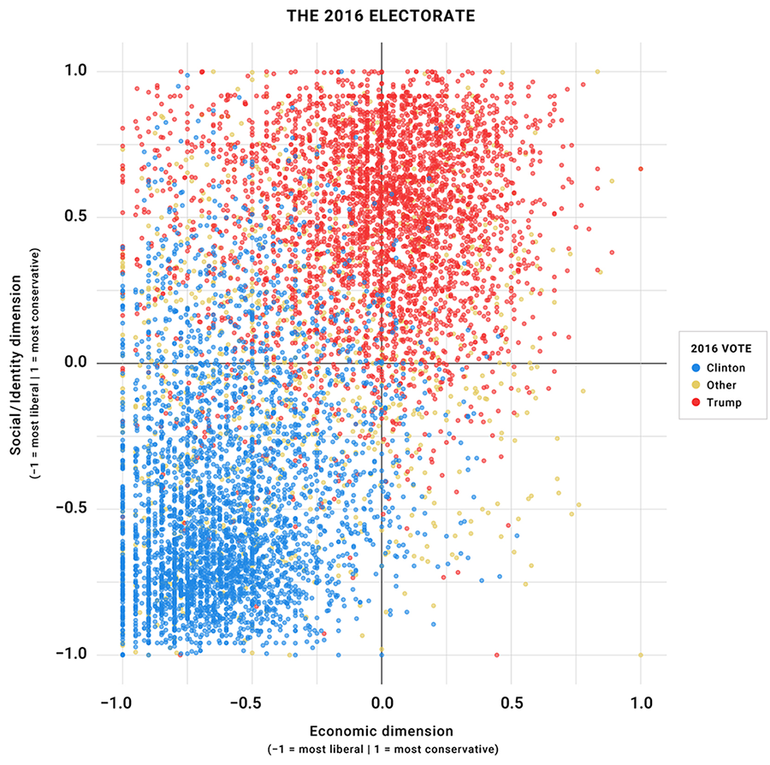
But what might be surprising to some is the fact that centrism is profoundly unpopular with most voters - but it is spectacularly attractive to advertisers so pundits must sell it to us relentlessly. If you need to visualize just how unpopular centrists are, this chart is most helpful.   


The lower righthand quadrant are voters who identify as “socially liberal, but fiscally conservative," i.e. libertarians and centrists. But even when combined together, they only compose a small portion of the electorate. If this was an aerial crowd photo, we'd wonder if they all had horrible body odor.

To put it another way, think of all those round table discussions on reproductive freedom or women’s rights where all the speakers are men. They are monstrous and absurd. But they are not unlike every discussion we have on class or the economy: Only rich people are invited to opine. 


EDIT:

This became a two-parter because you cannot bash sweatshop apologists enough. Part two is here.

___________

1) Broadly speaking, there are basically two kinds of conservatives: economic and cultural - and an increasing number of them are both. Likewise, academia roughly breaks down to the humanities and the sciences. Kristof concedes that many economic conservatives may prefer the private sector to academia because it is more lucrative. No shit. If you want to get rich, you are probably not going to major in philosophy or art history. As for the hard sciences, if you are a conservative geologist, you would certainly prefer to find new oil fields for Exxon than teach rocks for jocks" at a local college - ditto with chemistry, biology, etc. But cultural conservatives self-select themselves out of academia too because they are inherently hostile to the subject matter. Think of the humanities: There is the nude in art, gay writers, philosophers questioning the existence of God, etc. And forget the sciences because biology teaches evolution and geology teaches that the earth is millions of years old. Never mind global warming, the scientific method, and critical thinking skills as a whole. Unless whole subject matters are gutted of core content, most conservatives are going to feel uncomfortable in academia. Some might feel fine, but not the bulk of them.

2) Full Disclosure: Although I try to buy at least American made - if not union made - it is next door to impossible to not own some sweatshop-produced product. It sucks. But Kristof thinks it doesn't. This site has a mix of union and American made merchandise.

3) It's gotten too easy to flush-out frauds and I'm getting bored. So, here's a few pro tips to help the phonies out there improve their game and making things more interesting.

First, actual progressives are alarmed about economic inequality. Historically, we always have been, so we are sort of invested in it. Therefore, trivializing it may impact your credibility. 

Also, try to avoid pitting it in a false trade-off against race or sex because we progressives are pretty big into intersectionality and if you don’t know what that is it will show. Moreover, posing false trade-offs is a favorite conservative tactic (liberty vs. equality, jobs vs. the environment, etc.) and you don't want to blow your cover right away.

Second, we progressives generally consider ourselves on the left, so spouting Horseshoe Theory is not something any leftist would logically be inclined to do since we are loathe to associate with the right and highly unlikely to conflate the two. It’s a conspicuously centrist conceit and thus a great way to accidentally out yourself. Not to mention the fact that, if you are pretending to be a progressive while you are invoking that horseshoe horseshit, you are equating yourself with the far right. And lest you think moderation prevents moving too far along the arc, remember that Donald Trump is a textbook ideological moderate. Do not confuse the temperament with the ideology.

Moreover, I should also mention that conflating right and left is exactly what reactionary cranks like Glenn Beck and Jonah Goldberg do when they call progressives fascists." And that is not a good look on you or anyone else. I have written about this a bit previously.

Finally, when you say the left is a greater threat than the right, you have shown your true colors. Give up, go home, and find some honest occupation that does not entail slandering good people. It’s not the shooting star you really want to hitch your wagon to.

4) There’s a Facebook meme in which someone says she is thinking of naming her cats Thoughts and Prayers because they are useless.” I might name my next cat White Moderate.

Wednesday, January 4, 2017

It's Both, Stupid

When Bill Clinton first ran for president in 1992, there was a sign on his Little Rock, Arkansas campaign headquarters wall that read, "It's the economy, stupid."(1) It was a brief and blunt reminder to relentlessly hammer George Bush Sr. with this significant - and then signature - issue.(2)

Well, good luck getting many Clintonistsas or establishment pundits to admit that the economy impacts voter behavior today. The middle class has been shrinking and the wealth gap has been widening, but many busy wordsmiths hold the passionate conviction that voters are totally okay with that. According to their anything-but-the-economy arguments, nobody votes their pocketbook anymore and only spoiled college boys care about factory closings or job layoffs. Their breathless lectures on privilege and realism displayed zero self-awareness. They would be hilarious if they did not have such catastrophic consequences.

I am not arguing that racism and sexism were not factors in the outcome of this election – on the contrary, they were profoundly important – but class was a massive factor as well, and these writers don't seem to see wealth as a form of privilege. They are, at best, oblivious to the possibility that it might be, and at worst, in militant denial that it is. They can't imagine that it matters to anyone because it doesn't matter to them. And that, of course, is the very definition of privilege. So, small wonder they cannot possibly fathom how race and class interact. Indeed, they see the two as mutually-exclusive.

For example, take this little gem purporting to prove that economics had nothing to do with Trump's win because - drum-roll, please - his supporters are split on the issue of trade.

No shit. Both parties are. Republicans were practically the exclusive party of "free trade" until Bill Clinton passed NAFTA. It's a pretty libertarian pro-business position, so OF COURSE a huge hunk of Republicans still favor free trade. Trump just used anti-NAFTA rhetoric to peel away enough blue collar votes to swing the Rust Belt.

This could have alienated traditional white collar conservatives, but it didn’t. They correctly reasoned, "Trump doesn't really mean it: He's a businessman. He makes most of his merchandise in China." Conversely, many working class voters disastrously rationalized that Trump did not really mean his racist rhetoric, but hoped against hope that he might move the needle on trade and voted accordingly. In short, most of the people who voted for Trump did so because they thought he was lying.(3) Some did from a position of affluence and strength and others did from a position of desperation after decades of declining fortunes. Watch both videos. They are heart-rending.

So white collar conservatives accordingly stayed put instead of bolting across the aisle into Hillary Clinton's camp. Apparently, all those establishment GOP endorsements she chased down had no benefit. Indeed, in this anti-establishment climate, they were a definite detriment with many voters in both parties. Moderate Republicans were supposed to flock to her banner in the spirit of sensible bipartisanship. Of course, that did not happen.(4)

What accounts for the confusion of that article’s author? Best guess says abysmal historical illiteracy and going by Trump's statements in that vacuum. Not only was the GOP's pro-business proclivities unknown to her, she was apparently unaware that working class whites do not have a monopoly on racism. Indeed, racism has been driving suburban growth since the Fifties. White flight has long been monetized and politicized – frequently violently. The suburbs are not quite bucolic bastions of liberal enlightenment.

This impacts trade politics. Remember Rush Limbaugh’s racist defense of NAFTA:
If you are unskilled and uneducated, your job is going south. Skilled workers, educated people are going to do fine 'cause those are the kinds of jobs NAFTA is going to create. If we are going to start rewarding no skills and stupid people, I'm serious, let the unskilled jobs that take absolutely no knowledge whatsoever to do - let stupid and unskilled Mexicans do that work.
The suburbs are filled with people who think like this; which is why those so-called soccer moms who were supposed to break for Clinton stayed with Trump instead. These people hate unions, go to high-tech suburban mega-churches, and love the fact that they can buy stuff at Walmart for next to nothing because that's what the people who make it are paid. These Paula Deen-like ladies would love to have their own slaves. Alas, "political correctness" and the Thirteenth Amendment prevent that.

And lest this salient facet escape your attention: Rush Limbaugh was not siding with Bill Clinton - Bill Clinton was siding with Republicans (who Rush Limbaugh spoke for). George Bush Sr. had negotiated NAFTA, but Bill Clinton fought his own party to secure passage.(5) The Clinton Administration went so far as to have Al Gore debate Ross Perot about it. Overt support doesn't get much more theatrical than that. That’s the problem with making memorable moments - people remember them. And they remembered in 2000 when Al Gore was running.(6) But, no, let's blame Ralf Nader even though NAFTA was why we lost Congress in 1994 and had such great difficulty holding onto it ever since. Recall that we had a virtual lock on Congress for several generations since the New Deal.

Arguing that white working class votes were a big factor in Trump's win is not the same as saying most Trump voters were white working class – just that a strategically significant sliver of them were. Indeed, studies discovered that most Trump supporters were fairly well off. Earlier, the same fact was discovered about Tea Baggers. The popular misconception that they were mostly working class people voting against their own economic interests was wrong. When these studies were first released they provoked puzzlement. They should not have. It just means they are typical suburban Republican voters – the ones centrist Democrats were willing to betray working class voters to get.

You may be thinking, “Jerome, lay off the article's author. She’s probably just a kid.” If so, that’s both ironic and irrelevant. Ironic because Millennials are inexplicably one of Clintonitsas’ favorite scapegoats just now. Irrelevant, because the mainstream media is filled with equivalent gibberish. The article epitomizes both. There's less and less daylight between click-bait websites and the press.

During the 2012 election, Fox News and other conservative outlets told its viewers that Mitt Romney – a man who said “let Detroit go bankrupt” – was going to beat President Barack Obama in a landslide. But the landslide slid in the other direction. A pretty predictable scramble for half-assed rationalizations ensued. This year, the rest of the corporate media assured us that Hillary Clinton would crush Trump and when that did not happen a similar spectacle followed that debacle.

In both cases, the loser had alienated labor. Bigly. Perhaps that's a bad strategy for both parties.

_______________

(1) Actually, it was just "The economy, stupid" but everyone remembers it as “It’s the economy, stupid.” I am going with the more familiar form to make my post’s title work.

(2) But it was also a directive to display empathy towards the victims of the “mean season” that Ronald Reagan began. For working people, his Thatcherite austerity measures meant union-busting. For the rich, it meant a party on borrowed money. George Bush Sr. had promised “a kinder, gentler nation.” (It was an odd promise after the Willie Horton ads that got him elected.) But it was not gentle enough. Bush infamously promised “No new taxes.” But the bill for Reagan’s party was due and Bush broke his improbable promise. Pro-business policies meant exporting jobs and the economy was already feeling the pinch. And here came Bill Clinton with his Kennedy-esque youth and charm.  Most people wanted to believe Clinton would reverse the perverse zeitgeist Reagan had inaugurated. Instead, Clinton co-opted it – shortly after his Sister Soulja moment.

(3) Interestingly, both candidates followed the same strategy: Poach voters from your opponent and hope that your base thinks you do not mean it. At her private fundraisers, Hillary Clinton assured Wall Street donors that her populist rhetoric was all for show. Clinton actually said it was necessary to have “both a public and a private position.” She mocked Millennials as “living in their parents’ basement” talking about Scandinavian style socialism “whatever that means.” I guess she doesn't really "love Denmark" after all.

(4) Hillary Clinton was banking on disgust for Trump, but vulgarity aside, Trump was not saying anything Republicans had not been saying for decades in more genteel terms. Republicans have been milking the Southern Strategy since 1964. It admittedly had peeled away a lot of white working class voters – indeed, it appealed to racists of every income but that escapes mention for some reason. Suburban voters inexplicably (okay, not inexplicably) get a pass. Trump just cranked up the volume. As I wrote before, "The [racist] dog whistles are now air raid sirens. All subtlety and plausible deniability has been spectacularly jettisoned." But the rhetoric was always there. What Trump did that was truly new was break with the GOP party establishment on trade. No GOP nominee had done this in modern times. Yes, Pat Buchanan had advocated this strategy, but the Republican establishment had always beat him back. Well, Donald Trump was Pat Buchanan's revenge, wall and all.

(5) During the primaries and well after the general election, I routinely ran into Clintonistas who insisted it was not Bill Clinton but George Bush Sr. who signed NAFTA. Actually both did. Bush had a signing ceremony after the treaty was negotiated, but the Senate had not yet ratified it by the 1992 election. Once in office, Bill Clinton pressured Democrats to secure passage and did the final signing. But hey, don’t take my word for it – just ask the Clinton Presidential Library. I was shocked that Rachel Maddow had pushed this bizarre narrative that Bill Clinton had nothing to do with NAFTA. Again, who can forget the Gore-Perot debate? Yet, to this day, Clinton supporters still deny that Bill Clinton had passed NAFTA the same way that Republicans deny Ronald Reagan had granted immigrants amnesty. (Indeed, Ronnie did.) Any fact that contradicts how they imagine the man is loudly ignored.

(6) It is important to note that Al Gore was not just going to bat for NAFTA against the wishes of working people but that he was smug and condescending about it. He was the hated Taylorist efficiency expert with the clipboard. Here was a managerial technocrat telling working voters that they were too simple to understand international trade issues that they understood all too well. They knew the treaty would pit them against Mexican workers in a race to the bottom in wages, hours, and working conditions. Al Gore’s performance validated every rightwing screed about the “liberal elite.” The debate played great with the yuppies in the suburbs, but it was a demoralizing, fuck-you gut-punch to the old New Deal coalition. Of course, it was supposed to be.

Tuesday, December 6, 2016

I’ve Been Jonesing

I was looking forward to seeing Free State of Jones in the theater since I first heard about it, but life intervened and I missed its brief visit to my city. Now that it is out on DVD, I finally got to see it.

It's excellent except ... It feels pretty white savior-y even though we see frequently blacks saving or helping the protagonist, Newton Knight. He is still the charismatic strategist who helps everyone else - both black and white - a lot more, so the mutual aid is often lopsided. In fairness, the film is following the folk hero story format and you are not likely to see a version of Robin Hood where Little John, Friar Tuck, and Maid Marian accomplish or contribute as much as the title character - although that would be awesome.

I don't like the heroic leader trope, but I understand the decision given the Robin Hood angle. 
(1) In this historical context though, it makes the white savior flavor a lot harder to avoid. What worked in Sherwood Forest, does not work so well in Jones County. And there are a few scenes where we see him supervise others work with a gun slung over his shoulder and it feels a bit overseer-ish (although these are with poor white farmers). Yo, Robin Hood Jesus, put down the shotgun and help shuck that corn y'all stole.

Granted, the supporting characters are not just opportunities for the hero to be heroic or define his sense of right and wrong. They are strong, smart characters in their own right, not cardboard cutouts. They are tantalizingly fleshed-out and brilliantly acted. And yet Newton Knight so totally dominates the story that we don’t see enough of them. This might be the unfortunate side effect of time constraints. You want this to be a miniseries instead of shoehorned-into one ambitious film. After all, it covers events from 1862 to 1876, plus flash forwards to the trial of one of his descendants. And you definitely get the impression that director Gary Ross is trying to show as much of the cast as he can. He clearly wants to explore their stories more. And yet, at the end of the day, the film is not about the community but its violent Messiah.

Newton Knight starts out with a class critique of the Southern plantocracy, calling Southern Secession “a rich man’s war and a poor man’s fight” which, of course, it was. Knight is not a bigot to begin with, but race is not initially on his radar either: Other poor whites were his focus. But he pretty easily incorporates race into his analysis as he is forced to hide with escaped slaves in the swamp. He realizes that slaves and poor whites are in similar boats, if not quite the same one.(2) We see the disgusted army deserter initially helping other poor white farmers fight off corrupt Confederate tax collectors and he winds up leading a biracial rebellion against a rebellion. After the war, he helps blacks vote during the Reconstruction.

This is not the standard dramatic Hollywood story where the hero agonizes over something, sees the errors of his ways, and works toward atonement. Instead, it is a pretty brisk, low-key evolution. We see an amazingly kindly person who was always quick to help others realize there is a larger circle of folks he must help. Knight has no economic or psychological investment in white supremacy to prevent him. There are no old inner demons to grapple with – just a new logical corollary to his preexisting core beliefs.

Knight is deeply religious, and yet the film interestingly avoids a thematically predictable, full-blown conversion narrative where his political awakening echoes a previous religious one. We don’t see the sinner become a saint. The takeaway is clear – and ironically secular: If you are a decent independent person, i.e. not an indoctrinated bigot, common sense and evidence inevitably take you to Knight’s conclusions.

Yeah, it’s a bit of a forced march story-wise, but it is absolutely historically accurate in terms of the societal dynamics and the larger contours of the story(3) and, again, different from what you typically see on screen, so props for that. Paradoxically though, Knight comes off as almost too saintly as a result because he is a pretty perfect hero from the start.

Except he is and he isn’t. Newton Knight is animated by righteous indignation. Yes, he is angelic to the oppressed, but he will take a bowie knife to your throat if you are an oppressor. Sometimes he is forgiving and merciful, other times not. He is as brutal as he is gentle and Matthew McConaughey does a great job of credibly portraying this contrast. Newton Knight is not Thomas Merton, but Jesus Christ chasing the money changers out of the temple – except with a shotgun instead of a whip. 

Some reviewers mocked the character as impossibly enlightened, but why is it so difficult to imagine such a figure? John Brown was just one of many militant abolitionists back then - hence the bloody dress rehearsal for the Civil War fought in Kansas and Nebraska which Brown participated in. Newton Knight is a similar figure. And likewise he is the tip of the iceberg. I had first learned about the Free State of Jones from reading James W. Loewen's eye-opening book, Lies My Teacher Told Me: Everything Your American History Textbook Got Wrong. As Lowen explains, it was one of many such revolts: 
As early as December 1862, Pres. Jefferson Davis denounced states' rights as destructive to the Confederacy, The mountainous counties in western Virginia bolted to the Union. Confederate troops had to occupy east Tennessee to keep it from emulating West Virginia, Winn Parish, Louisiana, refused to secede from the Union. Winston County, Alabama, declared itself the Republic of Winston. Unionist farmers and woodsmen in Jones County, Mississippi, declared the Free State of Jones. Every Confederate state except South Carolina supplied a regiment or at least a company of white soldiers to the Union army, as well as many black recruits. Armed guerrilla actions plagued every Confederate state. (With the exception of Missouri, and the 1863 New York City draft riots, few Union states were afflicted with such problems.) It became dangerous for Confederates to travel in parts of Alabama, Florida, North Carolina, Tennessee, and Texas. The war was fought not just between North and South but between Unionists and Confederates within the Confederacy (and Missouri). By February 1864 President Davis despaired: "Public meetings of treasonable character, in the name of state sovereignty, are being held." Thus stales' rights as an ideology was contradictory and could not mobilize the white South for the long haul. (Page 183)
... In part owing to these contradictions, some Confederate soldiers switched sides, beginning as early as 1862. When Sherman made his famous march to the sea from Atlanta to Savannah, his army actually grew in number, because thousands of white Southerners volunteered along the way. Meanwhile, almost two-thirds of the Confederate army opposing Sherman disappeared through desertion. Eighteen thousand slaves also joined Sherman, so many that the army had to turn some away. Compare these facts with the portrait common in our textbooks of Sherman's marauders looting their way through a united South! (Page 184)
As I wrote before, the Confederate states had unquestionably seceded to preserve slavery. But that does not mean the populations of those states had supported the war effort or its root cause. You can find numerous books debunking the "Solid South" narrative. In addition to three-different-books on the Free State of Jones, there's Victoria E. Bynum's book The Long Shadow of the Civil War: Southern Dissent and Its Legacies. Looking at the states of North Carolina, Mississippi, and Texas, she shows us "Unionist supporters, guerrilla soldiers, defiant women, socialists, populists, free blacks, and large interracial kin groups that belie stereotypes of Southerners as uniformly supportive of the Confederate cause." Jesús F. de la Teja has edited a collection of essays focusing on Texas entitled Lone Star Unionism, Dissent, and Resistance: Other Sides of Civil War Texas. If you are interested in this history, Smithsonian Magazine's article on the Free State film is a good place to dip your toes into the material.

I worry that the film makes the Free State of Jones feel too unique: As the evidence above shows, similar insubordination was found throughout the South. It's a common problem with historical movies. Likewise, the World War I movie Joyeux Noel (2005) gives the impression that the 1914 Christmas Truce was an isolated incident rather than a widespread phenomenon seen sporadically along the trench lines from the North Sea down to the Alps. It's an inherent hazard of drama's emphasis on its characters - especially if the characters themselves have no knowledge of parallel events happening elsewhere.

I'm not knocking the movie. For all its faults, I enjoyed it. Moreover, it's important. It gives Southern whites real heroes, which can help wean them from the ones of their parents and grand parents. And, of course, the 
unreconstructed neo-confederate coelacanths at the Abbeville Institute hate it.

I cannot give a higher recommendation than that.

_____________

(1) I prefer stories that spread the wealth screen time-wise. This isn’t just an ideological tick of mine. It just seems more realistic – especially if you have studied historical movements. In Land and Freedom (1995), set during the Spanish Civil War, there is a fascinating scene where an anarchist militia debates whether to abolish property after liberating a village from Franco’s fascists. Teams of equals argue, which is why the group Avengers movies are more interesting that the solo ones and Captain America: Civil War is the best one yet. After all, it has the most Avengers in it. Stories come from conflict and more characters mean more motives in play. More band for your buck means more bang for your buck. 

(2) To its credit, the film both compares and contrasts to avoid drawing a false equivalency. When rescuing a freedman's "apprenticed" - i.e. abducted - son, Knight tells the father, "They will arrest me - they will kill you." Parallels with poor whites aside, the film does not forget that blacks lived in considerably greater danger. Their situations were similar, yet not the same. But they definitely shared the same enemy. A century later, that remains unchanged as working whites still vote against their economic interests.

(3) Some liberties were taken with the historical record insofar as individual characters were concerned. For example, As the director admits, Newton Knight did not have a nephew who died in his arms triggering his desertion from the Confederate army. Likewise, Moses Washington, the escaped slave he befriends in the swamp is a vehicle for showing many things that many slaves experienced. He is what is called a “composite character.” It's a standard practice in historical films.