Sunday, February 21, 2016

The Death Debate Again

Edit: This post was originally written before Greenwald went right. The principles still apply.

Supreme Court Justice Antonin Scalia died a week ago today and I am ashamed to say that I joined in on the tasteless schadenfreude-fest that swept the Internet. I must admit I said some terrible things.

Okay, I’m not actually ashamed and my jokes were really pretty tame.

But some kind-hearted liberals think I should be, so the traditional cycle of cheering and chiding ensued. The arguments against celebrating are familiar - they get trotted out whenever a malevolent political figure dies. Glenn Greenwald wrote a great essay about this on the occasion of Margaret Thatcher’s death. It was a follow up on an argument he made on the occasion of Christopher Hitchens' death.

Naturally, how terrible the individual was in life varies and I suppose we can disagree over whether the degree of glee is really proportionate to the departed's damages. Augusto Pinochet’s regime tortured and murdered thousands of Chileans whereas, in England, Margaret Thatcher’s austerity measures merely ground a generation of working poor deeper into poverty. And Antonin Scalia only sought to subvert equality and democracy in America, so I suppose it is all relative.

I can maybe see making the argument that only their victims have a right to raise a glass but that others do not. I disagree, but I can at least see it. But to say nobody should only silences the victims. It tries to shame them for their valid anger – particularly when the public figure’s crimes are gently finessed or totally ignored in a flourish of eulogistic praise, as is frequently the case. As noted in the Greenwald article, it is the praise that is truly tasteless. Those who tisk-tisk are the type that think it is rude to point out rudeness. 

But then how does rudeness ever get corrected? This politeness is enabling writ-at-large on the scale of nation states. Gallows humor towards, say, war criminals who escaped the gallows and died peacefully in their sleep is not only understandable but totally appropriate. It is scant, bitter consolation to the survivors; and I will not deny them that. They are unquestionably entitled to it.

Simply put, the “no matter how bad they were” argument makes no sense in the secular context of civic life. If the strictures of your personal religion command you to love everyone, then do so. But I am not Mohandas Gandhi or Martin Luther King. I did not sign up for either of their religions, so I am not bound by their precepts. The fact is that, contrary to conservative propaganda, liberals are ridiculously Christian in temperament regardless of their religion. Forgiveness, atonement - liberals love that shit. Even Darth Vader gets saved and comes back as a blue Force ghost - with an impressive celestial face lift, no less. 

But what gets me is that you do not even have to atone if you had ever held public office. Official liberal forgiveness is automatic. Grace is de rigueur, if not an unthinking reflex. I know that one of the dictionary definitions of "liberal" is "generous," but perhaps a measure of conservative restraint is required here.

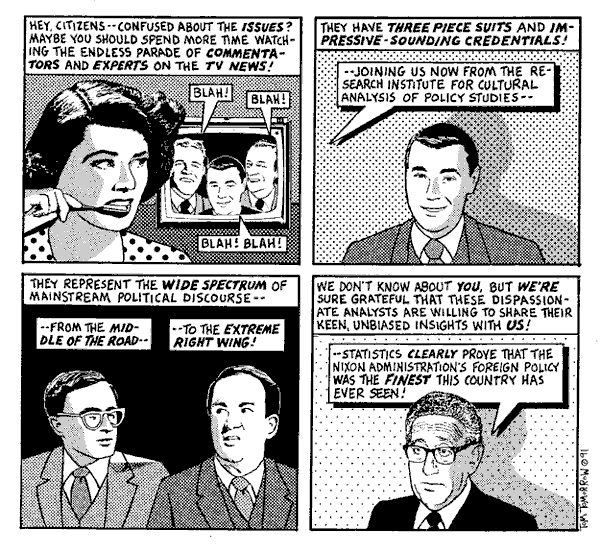
The thing is, I seriously think that society benefits from impolite timing. Last Sunday, I tweeted, "Political prediction: Opponents of genocide will cheer Henry Kissinger's death and be criticized for their insensitivity." I cross-posted it on other social networking sites and a friend objected that there should be no cause to cheer. I replied that it can turn the media's predictable whitewashing into a teachable moment. We must confront our history. The fact that Henry Kissinger is a free man and actually admired by the establishment reveals terrible truths about America that seriously need to be addressed.(1) Until he sits in a cage in the Hague, we cannot possibly call our nation a champion of human rights.(2)

The point here is that opportunities to talk about such figures are incredibly rare. Who would have guessed that Henry Kissinger would get mentioned in a Democratic presidential primary debate? TWICE! Secretary of State Hillary Clinton actually doubled-down on that endorsement. The second time, Senator Bernie Sanders could not let it pass again. His response was righteous and I quite approved. Kissinger had facilitated three different mass murders either by accident or deliberately.(3) Sanders only singled-out one of them, but even that one mention was a minor miracle. But everybody eventually dies, so that last opportunity is guaranteed. We should never surrender it.

Our country commits lots of atrocities and will continue to do so as long as we flinch from talking about them. Funny how it's always the "wrong time" to talk about it when people are paying attention. It's "unpatriotic" to criticize when the bombs start falling and "insensitive" when those who gave the orders peacefully pass away. It's only okay in between when the topic is not in the news anymore so nobody cares. 

How convenient! It's just like when conservatives insist we should not talk about gun control after another school shooting. It's never thought proper to solve problems when they are in the spotlight and therefore more likely to actually get acted on. It's always considered insensitive to prevent the next tragedy.

I think there would be a lot less liberal "vitriol" if the "liberal" media didn't whitewash manifest monsters. It legitimizes them and thereby encourages others like them. The fact that an obvious war criminal like Henry Kissinger is not only walking free but respected by the establishment and proudly touted by Hillary Clinton illustrates this sickness in our society. It's a chronic condition because we perpetuate it. If you want monsters to be more respected in death, your priorities are part of the problem. 

The news media should stop spin-doctoring sinister cadavers and treat their deaths as ordinary news stories. Write an obit, not a eulogy. Screw the usual slurry of polite, funereal obfuscation. If a writer wants to write eulogy, give the victims' case equal time. Granted, not every effort will equal Hunter S. Thompson's epic "eulogy" of Richard Nixon, but that rare effort should still be made.

But, hey, maybe I am wrong. I am always open to that possibility. Perhaps I should not toast the deaths of total toads. After all, there are a lot of them. As I noted in my book:
[T]he right’s icons have been dropping off like flies – Strom Thurmond, Ronald Reagan, Jesse Helms, Charlton Heston, Rev. Jerry Falwell, Paul Weyrich, William F. Buckley, and Robert Bork have all kicked the bucket since I had started writing this thing.
I need to start drinking less before I start seeing the Force ghost of Richard Nixon in the full youth and vigor of his early McCarthyite days. He's Blue, Rested, and Ready.


EDIT: Here's another argument against writing white-washing eulogies of political figures. Those who find mine insufficiently respectful might prefer Jeet Heer's podcast about Bob Dole's recent passing.

There's some genuine sympathy and admiration mixed-in; but it is not allowed to obfuscate the fact that Dole was a cold-blooded political opportunist and Richard Nixon's attack dog. His eulogies portrayed him as a principled statesman who put country before party, but he was the polar opposite of that. He was a vicious cynical partisan who not only endorsed Trump (no other past living Republican presidential contender did so) but facilitated the trajectory of the GOP that got us to Trump.

Heer is against flattering eulogies because they're bad history - but also because they erase the deceased's personality. Interesting characters become solemn two dimensional cut outs. Dole was a ball of frustrated ambition and bitterness, but he had a sense of humor about it. He wore it on his sleeve and owned it. It was who he was. These mawkish eulogies turn fascinating cads into boring heroes. 

This podcast was, in fact, fascinating.


SECOND EDIT: Liza Featherstone's obituary of Secretary of State Madeline Albright is  also excellent.

_______________

(1) Nationalists will naturally call this sentiment unpatriotic. Quite the opposite: You cannot fix problems that you refuse to recognize, and in a participatory democracy fixing things is a duty. As I write in my book, "Criticism is part of citizenship. Stifling dissent is a form of sabotage. It is like disconnecting an important dashboard warning light."

(2) This makes two recent posts that I am put in the awkward position of praising Christopher Hitchens, but his book, The Trial of Henry Kissinger is must reading on this topic. Watch the documentary of the same name, if you prefer. Secretary of State Hillary Clinton’s touting Henry Kissinger’s praise of her encapsulates all that is terrifying about her candidacy.

(3) First, the accident: The illegal bombing of neutral Cambodia during the Vietnam War may have killed as many as 150,000 Cambodians. That is not the accident part. The accident part was that it destabilized that country and allowed the brutal Khmer Rouge to take over and murder over a million more. Nixon and Kissinger's recklessness accidentally had helped the Khmer Rouge just as surely as George W. Bush had accidentally created ISUL (or Daesh, if you prefer). You could call it negligent genocide. It is a chronic blow back from bombing. As the first linked article noted, comparing Afghanistan to Cambodia, "The Khmer Rouge grew from a small force of fewer than 10,000 in 1969 to over 200,000 troops and militia in 1973. During that period their recruitment propaganda successfully highlighted the casualties and damage caused by U.S. bombing." Funny how similar actions in similar circumstances get similar results.

Installing the aforementioned Chilean dictator General Augusto Pinochet was the other mass murder that Henry Kissinger was an accomplice to, but that was no accident. Kissinger explicitly green-lit that slaughter. Generally, the dictators we chose to run other countries during the Cold War, asked our permission first. That was also the case when President Gerald Ford and Henry Kissinger approved Indonesia's invasion of East Timor. Indonesia massacred almost a quarter million Timorese - a third of that country's population. It's traditional. Indeed, a miscommunication in one protocol is what triggered the first Gulf War. Saddam Hussein sought - and thought he got - George Bush Sr.'s permission to invade Kuwait. After all, during the Reagan administration, we sold him the poison gas he used on the Kurds. Yes, we sold it to him to fight Iran, but we did not stop selling to Saddam after we discovered on whom it was being used. Kissinger was not directly involved in the sale, although he had betrayed them previously. No, that is Donald Rumsfeld seen shaking hands with Saddam.

Some quibble with the use of the word "genocide" arguing that specific ethnicities were not targeted. For example, this article argues that, in East Timor, the term is not technically correct in terms of international law. And in Chile, the targets were ideological rather than ethnic. But the Khmer Rouge's brand of communism was rabidly nationalistic and ethnic Chinese and Vietnamese Cambodians were targeted by Pol Pot's regime.

Wednesday, February 10, 2016

On Coates and Roosevelt

In preparation for my last post, I reread Ta-Nehisi Coates’ excellent essay “The Case for Reparations.” For the most part, it holds up. I have only one minor quibble with Coates’ essay but even this ultimately justifies him. Facts are frequently double-edged swords.

I think that Ta-Nehisi Coates was a tad harsh on the New Deal. Granted, the most important New Deal programs like Social Security and the Federal Housing Authority did indeed exclude Africa Americas. And the net effect dramatically widened the wealth gap between blacks and whites. There is no denying that and, at the end of the day, that is all that actually matters. But a casual reader might get the idea that preserving and strengthening white supremacy was the goal of these programs.

Not quite. Craven compromises were made out of weakness rather than malevolence or indifference. Such concessions are familiar examples of the Southern plantocracy holding the whole country hostage – something they had done since threatening to scuttle the Declaration of Independence. (There is actually a musical about that.) The New Deal era was no different. As Harvard Sitkoff admitted in A New Deal for Blacks: The Emergence of Civil Rights as a National Issue: The Depression Decade, the Roosevelt administration initially feared that aiding African Americans in any way would derail other legislation. Even as minor a matter as the invitation of a Negro to the Senate restaurant in 1934 resulted in Southern Democrats howling their rage and threatening to cut off appropriations."(1)

And this may very well be what Ta-Nehisi Coates means when he says that America was built on white supremacy - only that our country has been continuously structured to advantage whites and keep blacks vulnerable in various ways right up until the present day. If so, I cannot possibly argue with that. I may be misreading him on the New Deal.

           
But, as the title of Harvard Sitkoff’s book suggests, things started to change during the New Deal. Not all the credit goes to the Roosevelts or the New Deal. The Harlem Renaissance had inspired African Americans to take pride in their identity and assert their rights. (And, although Sitkoff is an integrationist, he has praise for Marcus Garvey on this score.) Black labor leaders were flexing their muscles. And unquestionably some credit goes to communists who were agitating on both class and race issues. More whites in the union movement began to grasp how racism is used to divide and conquer the working poor. Even conventional liberals noticed the Nazis’ brutal racism and asked how the Klan was any different. The logic of the New Deal coalition's forgotten man" rhetoric pulled toward civil rights even though it prioritized economic recovery and, later, getting Hitler. 

Within the Roosevelt administration, there were different opinions on this issue. Some were wary of offending Congress, while others favored pushing the envelope within the executive’s prevue. Among the later was Harry Hopkins, head of the Works Progress Administration, and Francis Perkins, Secretary of Labor. Both were once social workers in New York and sympathetic to the plight of Blacks. But perhaps the most powerful was First Lady Eleanor Roosevelt. She needed schooling but proved an apt pupil. As Sitkoff wrote of Eleanor's education:

Her friendship with Walter White of the NAACP and Mary McLeod Bethune, President of the National Council of Negro Women, began to resemble a crash course on the struggle of blacks against oppression. ... Like other liberals who initially viewed the race problem as essentially economic, to be solved by New Deal anti-poverty measures, Mrs. Roosevelt only gradually came to the realization that such specific matters as discrimination, lynching, and disfranchisement had to be faced directly.(2)
That last sentence pretty much sums up Ta-Nehisi Coates' critique of Bernie Sanders' answer on the question of reparations for slavery. Of course, I should add that Sanders has embraced the Black Lives Matters movement and believes that African Americans are owed an official apology for slavery. But with regard to the question of black poverty, Sanders program is indeed only class-based. Eleanor Roosevelt became a vocal advocate for a federal anti-lynching law, much to the chagrin of many White House staffers. And I have no doubt that Bernie Sanders is an equally quick study. But, yeah, this has often been a blind spot with socialists and liberals alike. 

It is also important to note that blacks benefited from some New Deal programs. This was when blacks began to switch their allegiance to the Democratic Party – a process completed by the 1964 Civil Rights Act. Before, blacks had loyally supported the “Party of Lincoln.” This was not just a byproduct of the second northward black migration during WWII. (The first was during WWI.) The efforts of Eleanor Roosevelt, Harry Hopkins, and Francis Perkins got some results. Of course, because these federal programs were locally administered, the gains were severely limited in the south; but they were noticeably effective in the north where blacks were migrating. 

But, again, evidence that supports this narrative also supports Coates. As Sitkoff wrote of the racist and timid climate in then Secretary of Agriculture Henry Wallace's department:
Henry Wallace, according to to civil rights spokesmen, especially feared antagonizing Southerners on the race issue. No other department was as controlled by white supremacists both in the bureaucracy and in Congress as was the Department of Agriculture. It had the smallest percentage of black employees and was the last to appoint a Negro adviser. You didn't dare take a Negro to lunch at Agriculture," recalled Dr. Will Alexander, one of the few supporters of civil rights working on the New Deal farm programs. Wallace not only ducked action on Negro rights but complained to Alexander: Will, don't you think the New Deal is undertaking to do too much for Negroes[?]"(3) 
This is a bit embarrassing for progressives because Wallace was their icon. Roosevelt later made him his Vice President (1941-1945), but then replaced him with Harry Truman - to the great ire of progressives. Truman and Wallace became rivals; and in 1948, Wallace ran as the Progressive Party's candidate for President thereby threatening Truman chances. However, by this time, Wallace had evolved a lot on civil rights becoming a stronger supporter than Truman, who desegregated the armed forces. The point being is that progressives haven't always been awesome. As I wrote before, the left's record is mixed - better than the liberal record to be sure, and far better than the conservative one, but it still has plenty of blemishes. 

There is a telling incident that illustrates both Franklin D. Roosevelt’s timorousness and the admittedly limited – but still significant – beneficial impact of the New Deal on blacks. In 1935, Georgia Governor Eugene Talmadge, then one of the biggest bigots in politics, wrote a letter to Roosevelt complaining that work relief projects paid too much. The upshot was local cotton barons could not get field hands for the starvation wages that satisfied tradition. Roosevelt wrote a tart response, but never mailed it. Instead, he then delegated the task of replying to Harry Hopkins. Hopkins wrote Talmadge that his favored wage rate left people under-fed, sick, and ragged, and their children out of school for lack of food, clothes and school books."(4) Race was not specifically mentioned in either Roosevelt's or Hopkin's response. It was understood. But just in case it was not clear to the reader, the 1957 book this bit comes from introduced it with this opening sentence: Talmadge was one of the most vociferous white-supremacy Southerners of the era." Hopkin's letter was still critical in tone, but it significantly did not come from the president.

Let’s not equivocate: This was not a heroic moment for Roosevelt. And Coates’ disappointment with the New Deal generally is unquestionably justified. If it seems like an example of “same old/same old,” that is because that is exactly what it was – a story that is quite literally as old as the republic itself. However, nor is this evidence that Roosevelt approved the perpetuation or strengthening of white supremacy. It is certainly disappointing, but not evidence of intent or desire. Yes, this is a defense of FDR, but it is hardly a rousing or inspiring one. And, hey, I can make it even worse by pointing out Roosevelt's internment of Japanese-Americans, which was active rather than passive and – as Coates correctly points out – an instance where America has actually has made payments to an injured ethnicity.

But like I said, this is a quibble. At the end of the day, Ta-Nehisi Coates is right about reparations. What actually matters is that, whatever Franklin D. Roosevelt’s intentions, much of the New Deal was a massive whites-only giveaway which unquestionably widened the wealth gap between whites and blacks. And its effects are felt to this day. Conservatives cannot deny that and complain about the inheritance tax. And the subsequent G.I. Bill – arguably the first federal affirmative action program actually implemented – was also whites-only. Indeed, contrary to the absurd conservative fantasy that Martin Luther King would have opposed affirmative action, he not only helped pioneer it, he also likened it to the G.I. Bill. And, as Coates notes, blacks trying to buy homes were denied legitimate credit sources and thereby herded into predatory scams – and variants persist to the present day. Government collusion was always a part of this. The grievances so go far beyond slavery. If you doubt me, read his essay already.

I may be wrong, but my reading of Ta-Nehisi Coates is not that he is denying the contributions of socialist solutions insomuch as saying that there is another important, studiously ignored piece to the puzzle. Socialism solves a lot, but it doesn’t solve everything.

So let's emulate 
Eleanor Roosevelt and recognize that.

________________

(1) Harvard Sitkoff, A New Deal for Blacks: The Emergence of Civil Rights as a National Issue: The Depression Decade (Oxford University Press, 1978), 45.

(2) Ibid., 60.

(3) Ibid., 44.

(4) Franklin D. Roosevelt, The Roosevelt Reader: Selected Speeches, Messages, Press Conferences, and Letters of Franklin D. Roosevelt, ed. Basil Rauch (New York: Rinehart & Co., 1957), 137.

Tuesday, February 2, 2016

On Bernie and Ta-Nehisi

Ta-Nehisi Coates recently wrote an interesting piece for the Atlantic. It asked why Senator Bernie Sanders does not support reparations for slavery when he advocates so many other ambitious proposals that are supposedly doomed too. When did the radical Sanders become such a safe pragmatist all of a sudden?

In the interests of full disclosure, I am a Bernie Sanders supporter. But I am also working on a follow up book on the ideal of equality and conservatism's eternal hostility toward it. One chapter deals with the issue of reparations. I am pretty convinced and Ta-Nehisi Coates 2014 Atlantic cover story, The Case for Reparations" has played a part in that.(1) His prose is both powerful and persuasive.

Let's first talk about reparations for a moment.

I did not set out to discuss reparations in my second book. My goal was to look at conservatives’ bogus opposition to group rights” in their anti-affirmative action rhetoric. They insist that there is no such thing as group rights despite their adoration for states rights and corporations. Their insistence that this is a Christian nation" is another overt endorsement of group preference” and I suspect they have many covert ones as well - like race, for example.

I also wanted to look at how conservatives conceptualize justice and concluded that they like authority and having an excuse to use violence and feel righteous about it, but that balancing the scales without any gun play apparently fails to ignite their enthusiasm. Hostility, yes. Enthusiasm, not so much.

In the process of all this, I quickly discovered that making reparations for slavery was an issue that no student of American history could honestly ignore.

Let's get something out of the way. Perhaps this reveals the limits of my imagination or my chops as a writer, but there is no polite way to say this that does not shortchange the facts or do outrageous violence to logic or the English language. The right’s arguments against reparations are bat-shit racist.  

Of course, the ever horrible David Horowitz's ten point newspaper ad proved that back in 2001. I was amazed that the late Christopher Hitchens’ take-down of it did not connect the last dot. (2) When Horowitz said it is actually blacks who owe America, the best Hitchens could muster was, Smile when you say that, David." Hitchens' critique was otherwise epic. It is a pity that the mainstream media could not match those standards. Instead, a superficial acceptance of Horowitz's absurd assertions prevailed.

In his famous Autobiography, Benjamin Franklin wrote that reading a poorly-argued book against deism was what made him a deist.(3) Arguments against reparations have a similar effect on most thinking people if they bother to wade into them, which is why most don’t. Whatever your stance on reparations, the right’s tortured rationalizations against them are as viscerally illuminating as flipping on a light switch in a darkened slaughterhouse. The smell tells you exactly what to expect so most back out beforehand.

So what do I think of Ta-Nehisi Coates' critique of Bernie Sanders?

Well, there is a lot that I cannot really argue with. I agree that the word divisive" was ill-chosen. Likewise, I agree that singling out Sanders was not unfair because Hillary Clinton never claimed to be a radical, parody notwithstanding. And historically the left has had a mixed record with recognizing that socialism doesn't solve everything.

My objection centers on the question of Bernie Sanders’ alleged pragmatism or lack thereof. Calling yourself a democratic socialist certainly sounds quixotic. And Ta-Nehisi Coates is quite right that Sanders picks his battles, so asking what yardstick the candidate uses is a valid question. But it is a question that Coates has actually already answered, although he does not seem to be asking it rhetorically. When not calling Sanders' agenda D.O.A., Coates notes that it is well inside the Overton Window. Isn't that contradicting himself? Well, not exactly. And there's your answer.

Sanders' strategy is to champion already popular proposals. It's about pounding obstructionists in Congress. Admittedly, it may take more than one electoral cycle. But the metric he uses to pick his fights is strategic, not naïve. Presently, reparations do not enjoy the same popularity as, say, breaking up the banks. Therefore, more agitation for slavery reparations remains necessary. In short, Sanders is picking difficult but currently winnable battles. One of which is reviving democracy. Is that radical?

Vis-à-vis the people, no. Vis-à-vis the system, yes.

Coates is correct when he says that Sanders is not actually all that radical. As Political Compass notes, Sanders is just slightly left of center - which is where the bulk of the frustrated voting public actually is. Energizing that public and demanding why we don't have nice things like Scandinavia has is his leverage.

Does this mean that Sanders is hostile to reparations? Not necessarily, although the word divisive" certainly suggests he might be.
But if so, he has proven himself quick to evolve and get in front of progressive change. We very recently witnessed a beautiful revolution in people's attitudes toward LBGT rights and Bernie Sanders embraced them early. Reparations might follow.

Does this sound like
an odd mix of optimism and cynicism? Well, all political commentary is and mine is no different. Yes, leaders should lead and make difficult and unpopular decisions. But few have ever run on promising them. Lincoln's platform was modest when he first ran for the presidency: All he promised was no slavery in the territories. He believed that was all the Constitution would allow him to do. Likewise, in 1932, there was almost no daylight between Franklin D. Roosevelt's platform and Herbert Hoover's.

My best guess says that Ta-Nehisi Coates already knows all this and wrote his piece on Sanders in part as an act of agitation for reparations. If so, it worked beautifully and I approve.

______________

(1) My only objection is not really an objection but a caution. Never underestimate the right’s capacity to twist an idea. Conservative columnist Charles Krauthammer has suggested using slavery reparations to replace affirmative action. Monstrously, he had proposed them in exchange for all affirmative action programs, including those for women and other minorities who would get nothing. Krauthammer’s attempt to drive a wedge between disadvantaged groups was pathetically obvious. It is one of the handful of tactics conservatives routinely use – like presenting false-trade offs. Could reparations be used to preclude future class action litigation like the Tobacco Settlement does? Depends on how it is structured. As I type, details on the poisoning of Flint, Michigan’s water supply are coming to light. And the predatory, systematic disaster gentrification of New Orleans after Hurricane Katrina is still raw. Both show that the targeting of black communities en masse remains ongoing.

Of course, poor execution does not invalidate a righteous idea and none of these scenarios are inherent to the concept of reparations. Moreover, reparations would, in the long term, make black communities less easy targets thereby lessening the vicious cycle of victimization.

(2) Christopher Hitchens, Debt of Honor," Vanity Fair, June 2001. Reprinted in Raymond Winbush's  Should America Pay? Slavery and the Raging Debate on Reparations, (New York: Amistad), 2003. I have been critical of some of Hitchens' positions - one of which, the invasion of Iraq, proved disastrously wrong - but not only was he right here he consistently kept pushing.

(3) Speaking of Benjamin Franklin, in my book, I point out that the founder of America's first anti-slavery society had made the argument that simply freeing slaves was insufficient. After listing the psychological scars of slavery on the freedman, Franklin adds, He is poor and friendless; perhaps worn out by extreme labour, age, and disease." Franklin's solution was education and job training. His aims now sound both modern and modest. Granted, Franklin’s language could accurately be described as “not entirely awesome.” As I wrote, While it is easy to be cynical about 'education calculated for their situation in life,' such organizations often provided promising freedmen with college educations and professional training." But part of Franklin's argument remains radical" today - his appeal to duty. Franklin felt, “Attention to emancipated black people, it is to be hoped, will become a branch of our national policy,” because “that attention is evidently a serious duty incumbent on us.” Again I ask how much longer will it take for today’s conservatives to catch up with Benjamin Franklin. Contrary to conservatives' inconsistent individualism, the concept of collective responsibility is neither new nor un-American. In Coates' Case for Reparations," he cites many contemporaries of Franklin who agreed that granting freedom was not enough. (Their language was arguably more awesome.) It was just as obvious to honest people then as it is now - the operative words throughout being “obvious” and honest."

- Benjamin Franklin, Writings of Benjamin Franklin, ed. Albert Henry Smyth (New York: Macmillan Co., 1907), 10:67.

Monday, January 25, 2016

Feeling Slightly Less Futile

Great googly-moogly! Somebody possibly reads my blog!

(Outside my circle of friends and robots from Russia, I mean.)

A short time ago, I wrote a post called "Misogyny? Seriously?" which questioned the prevalence of "Bernie Bros" who supposedly defined Bernie Sanders' supporters. I did not question that they existed. Every group has terrible members who don't get it and need a talking to. But I strongly doubted there were very many, mainly because Bernie Sanders had essentially inherited the draft Elizabeth Warren movement.

So imagine my delighted surprise when I ran across an article entitled, "Progressive Brothers: You Don’t Have to Hate Hillary to Love Bernie (and Don’t Drag Elizabeth Warren Into It)."(1) 

WOOT! SOMEBODY RESPONDED! Sort of. 

Or maybe not. It is entirely likely that the same thing has already occurred to others.

Okay, probably the latter. I mean, the article probably does not address my arguments because it was not written to address my arguments. But still, the article has problems I feel I need to address because this is the Internet and I have a blog. WITNESS ME!(2)

The main problem with the article is suggested by the title, or rather the author's explanation of it: 
The title of this piece is purposely direct. Every time I raise the issue of sexism in 2016, every time I point out that the blind, irrational hatred of Hillary is driven by more than just support for her opponent, I get the same response: Elizabeth Warren.
Somehow, it’s OK to bash one female politician if you can name another one you like.
Wait. Is this guy saying that I cannot mock Sarah Palin or Michelle Bachman either?

Probably not, but I think I know what he was trying to say, even though it came out wrong. He is suggesting that a kind of tokenism is afoot, and in some instances he is likely right. After all, it is certainly possible that Bernie Bros are cynically invoking Elizabeth Warren the same way that, say, white racists routinely compare themselves to Rosa Parks. Shit, it is not only possible, but probable. It is easy to say you support Warren after-the-fact since she is not running.

But it would be equally dishonest to ignore the fact that progressives really wanted Warren to run. And we really wanted her to run. Accordingly, we convinced ourselves that we could persuade her. We took hope in the fact that she pointedly (still) had/s not endorsed Clinton despite (once again) Clinton being anointed as the inevitable nominee. Warren's obvious lack of enthusiasm for Clinton mirrored ours. In my aforementioned post, I linked to an interview Warren did with Bill Moyers in which she expressed her profound disappointment with Hillary Clinton.

The point is I don't think the majority of Warren's supporters were faking their enthusiasm so that they could switch their allegiance to a male candidate at some later date. I don't know if any of the folks pushing the Bernie Bro story actually believe that. But there are only two logical implications to their narrative and neither of them is one that centrists have really thought out: Either the progressive movement is dominated by misogynists pretending to be feminists or it is far larger than they wish to admit. This puts them in a bind because the first possibility is paranoid and the second is demoralizing.

So, pick your poison: The vessel with the pestle or the chalice from the palace. The later has the brew that is true, but I think you will still find it pretty bitter tasting.


______________

(1) The site of the article, Blue Nation Review, has been a Clinton organ since last November.

(2) There, in two words, is the sum total of Twitter. Yeah, I got one of those.

Tuesday, January 19, 2016

New Atheists and Old Bigots


I must admit that I have not paid sufficient attention to the “New Atheists.”

I suppose I am what one of my friends calls an “old atheist.” Like him, I had rejected religion by my teens and moved on to other things. As my friend likes to say, “There is only one atheist book you really need. It reads, ‘There is no god. The End.’” On to improving the human condition.

Accordingly, I identify as a humanist. To clarify, not the way Men’s Rights Activists twist the term to malign feminists.(1) I mean in the sense of the American Humanist Association which has honored Gloria Steinem, Alice Walker, and Barbara Ehrenreich.(2) Specifically, I identify as a secular humanist since religious humanists also exist. But secular humanism has always struck me as the logical extension of atheism. I advocate the advancement of humanity and the celebration of its achievements.

This tightly ties into both my book and this blog because I believe that humanism is inherent in the Enlightenment's generous conception of patriotism which I contrast with narrow nationalism. Concepts like The Rights of Man transcend nation states. And as Mary Wollstonecraft (England), Judith Sargent-Murray (America), and Marie Olympe De Gouges (France) asserted, the Rights of Man must mean humanity, women very much included. True patriotism strives for liberty, equality, and democracy for everybody. It is therefore universal and internationalist.

Historically, humanists have been super-polite. Carl Sagan was kindliness personified. Indeed, he seemed nearly saintly. It is impossible for me to imagine him raising his voice. I am not saying that his politeness is a mistake – I think he is someone most people should emulate. However, the good cop/bad cop dynamic is missing and we need people like me to be assholes. And one thing I think that the New Atheists are doing right is getting confrontational. The objections to doing so are identical to the ones used against every minority that has tried to assert their rights.(3) As groups like Act Up and Black Lives Matter understand, you have to bother people. Certainly, we humanists have never shied from asserting ourselves: We have always advocated coming out of the theological closet. But we have rarely gotten really obnoxious about it and that made us heretofore easy to ignore. So, I have no problem with being rude or obnoxious. I am a sometime cartoonist and a fan of satire, so how could I?

But that does not mean that I condone bigotry just because it generates controversy. And the New Atheist movement seems to increasingly resemble Donald Trump's campaign – often dominated by Islamophobic rhetoric. Perhaps they should be called "paleo-atheists" after the paleo-libertarians some run with.

I have not read enough Richard Dawkins or Sam Harris to say how personally responsible they are for this. We should be cautious judging figures by their followers.(4) Some apologists say that their writings are more nuanced than Salon.com suggests. Although, Harris saying that "most Muslims are utterly deranged by their religious faith” is certainly not a good sign – likewise with Richard Dawkins calling Islam an “unmitigated evil.” My point here is that there are a lot of vocal Islamophobes calling themselves atheists and making shockingly shoddy arguments that are inconsistent with a scientific mindset.

Take the one that they are only attacking the religion and not the people. Turn that one around in your head for a moment. No, I mean really turn it around: You would not say that atheists should not feel threatened when politicians demonize atheism, would you? Of course not because you know that an assault on our rights comes next. Remember President George Bush, Sr.'s comments on atheists. And recall Poppy was the moderate George Bush - the "kinder, gentler" one. Regardless of how successful you think they would be, the trajectory of such rhetoric is never in question. Likewise, there is precious little “love the sinner, but hate the sin” in the Westboro Baptist Church’s “GOD HATES FAGS” signs, so it is a pretty fragile distinction and I strongly suspect planned obsolescence is in play.

Claiming that Islamophobia is not racism because “Islam is not a race” is another dud stock argument. It keeps cropping up despite its being so easily debunked. Yes, Islamophobia is not racism but an entirely different kind of bigotry – minus the word “entirely” because fear of a brown planet is part and parcel of the hostility. Likewise, sexism and homophobia are entirely separate prejudices.

This post is prompted by a debate that I had in and atheist discussion group about a month and a half ago. Yeah. But for the most part it was okay. I only had to deal with one overt racist and he dropped out after the first day. But, boy howdy, was he ever racist! Here is a sample:
Point is don't feed me this tolerance shit, Christians have nativity scenes up and you want to take them down yeah very tolerant but a Muslim who believe that people who leAve the religion should be put to death let's be tolerant guys.

This page takes no prisoners on Christians and their beliefs the you turn around and take up for Muslims who throw gays off roofs because they are gay and yes even the nice Muslims think gays should be persecuted for being gay but yet again when it comes to them let's be tolerant.

This is where the PC thing comes in you only take up for Muslims because they are a different race than WHITE, you have no trouble making fun of a Christian because we live in a time where it's cool to hate white people for being white.
So much for the claim that Islamophobia has nothing to do with racism.

Also, for the record, I do not condone throwing LGBT people off roofs. However, I will go out on a limb and guess that this guy probably does not really care about gays and was cynically concern trolling. His contempt for tolerance telegraphed that pretty clearly. Pro tip: You are less convincing when you rant about political correctness. Also, your silent dog whistle is actually quite audible.

Oh, and one more thing: Defending the separation of church and state isn't intolerance. Festoon your homes and houses of worship with whatever religious brick-a-brac you like. Buy billboards. Whatever. Just do not do it on public land or on the taxpayer’s dime. Because once you do that, you are enlisting the prestige of the state to promote your faith and proclaiming special status. Calling this commonsense precept intolerance is either ignorant or dishonest.

Yes, only one guy got explicitly racial, but he was not the only one bashing political correctness. It was almost like the 12/15/15 Republican primary debate. Pinball machine bells dinged when the candidate's time was up, but it seemed to be for whenever they said “political correctness.” They all knew that they had to push that button by the end of their answer/sound byte.

Another common comment was that I was somehow hypocritical for defending Muslims or that I thought that Islam was above criticism. Not at all. I was just pointing out how easy it was to cherry pick horrific passages out of everyone's sacred texts and it seemed that they had Sharia Law pretty much covered. And it turns out that most old holy books sound pretty much alike. I had also pointed out several recent incidents of Christian terrorism - including one that had just happened. And I also mentioned the fact that presidential candidate Ted Cruz sought and got the endorsement of a pastor who favors executing homosexuals. And he was not the only GOP hopeful seeking the pastor's blessing.

Of course, my debate opponents still insisted that none of this really counts and that Christianity had gotten such extremism out of its system. As evidence, they said America has no such laws. Um, that's not for want to trying. But if zealots fail stateside, they often succeed overseas. American Evangelical pastors essentially authored Uganda's "Kill the Gays" bill and they are pushing draconian anti-gay legislation all over Africa. They give Russia's anti-LBGT laws lots of love too. It's like the post-Tobacco Settlement strategy of the cigarette industry: Lose in America, pedal your poison abroad.

The point is that such ugly impulses remain. And those who I was arguing with puzzlingly gave America's secular safeguards precious little credit for keeping them in check.

Indeed, their argument that other religions had somehow gotten over their violent texts made me question the sincerity of their criticism of religion. It turns out that they think religion is actually pretty okay - like The Hitchhiker's Guide to the Galaxy described Earth: "mostly harmless." It's just that one particular religion that's really nasty. In their weltanschauung, Islam is the exception that proves the rule. In short, apologists were calling me an apologist. But that was not nearly as funny as their linking to fundamentalist Christian websites as credible news sources. Yes, one person actually cited World Net Daily. Meet the new Islamophobes: Same as the old Islamophobes. Or close enough. They apparently drink from the same well.

I’ve asked around, and discovered that friends have had similar experiences. All of the New Islamophobes’ arguments are pretty shoddy and have often been debunked before. But that does not stop them from repeating them. It is as robotic as a catechism recitation. To true believers, a talking point is an article of faith. They are so enamored with its imagined cleverness that they cannot be objective about it. They are incapable of recognizing that it is actually a moronic argument that could only convince a hardcore convert like themselves. Their rhetorical gold is sophomoric dross: The Dunning-Kruger Effect in action. If they could perceive their embarrassing shellacking they would take it as a test of faith. But they cannot and take it as your failure to understand. Hence the repetition.

Obviously, atheists are by no means immune to dogmatism. Take orthodox Marxists or Ayn Rand’s “Objectivists” (who Robert Anton Wilson often called "Randroids"). The interesting thing here is I was essentially accused of heresy. The overtly racist atheist said I was "giving real atheists a bad name" with my "hypocritical" tolerance. My atheism was questioned because I doubted that one religion was significantly worse than another. I did not know that was something that we had all agreed on. Did we have a meeting on this? I must have missed the memo.(5) Accordingly, my ideology was incorrect and not approved by the party. In retrospect, the experience was almost Maoist.

Let me emphasize that the atheist discussion group in question has plenty of good folks who have made posts against Islamophobia. That's important because Islamophobia must be acknowledged and confronted. There is no acceptable form of antisemitism. Secular humanists especially must confront this. Tolerance is not just a bedrock principle but something we have also benefited from. So when atheists foster religious intolerance, it is dangerous, ironic, and conspicuously pisses on what desists and atheists have been trying to achieve since the Enlightenment and I am going to call it out.


_________________

(1) Likewise, white racists like to reply to the Black Lives Matter movement by saying “All Lives Matter.” Yes, but not all lives are equally threatened. Thus, I do not think these white racists really believe that “all lives matter.” If they did, they would share the outrage of their fellow human beings. By the same token, those who want to keep women subjugated can hardly call themselves “humanists.” Their hostility to half of humanity disproves it. They claim that women have gone beyond achieving equality and now enjoy greater power than men. But when they articulate their aims, it is “a man’s world” rather than an equal one that they seek. Both the “All Lives Matter” and the MRA twist on “humanist” are obviously dishonest and an idiot’s idea of clever. Only an ignorant bigot could find them convincing.

(2) Full Disclosure: I am not a dues-paying member of the AHA, although I used to subscribe to their magazine. So what I am saying might be slightly off and is certainly not an official position of the organization. If anyone in the AHA spots a faulty assumption, please feel free to correct me. I am using the term “humanist” broadly and this is my impression on the current state of atheism. Your mileage may vary.

(3) I do not think that atheists are “the last” or “most persecuted” minority. I do think polls that show that most Americans are least likely to vote for an atheist show a disturbing and ironic contradiction in American society. (How many of the founding fathers who were deists could get elected today because of that?) But, let’s keep things in proportion here. Again, it is not like there is an epidemic of cops routinely shooting atheists at traffic stops and getting acquitted for it. And it is not like atheists are paid less than the faithful – like women are paid less then men. Other minorities are far worse off and anyone who dismisses their hardships – while cynically invoking those same hardships as metaphors for their own struggles – abdicates any claim to be taken seriously. The dynamic might be similar, but the scale sure ain’t. And that absurdity does your claim more harm than good.

(4) I have heard that both Richard Dawkins and Sam Harris have disavowed the “New Atheist” label. Likewise, Karl Marx had also insisted that he was no Marxist. To quote the Deadly Bulb in “The Tick” TV show, “Heh. Minions.” Alas, labels are like that. Few folks know that Machiavelli wrote The Prince sarcastically. He was an advocate of independent republics and his “advice” to a prince was actually ridiculing the crimes of kings. Similarly, George Orwell was an obvious opponent of “Orwellian” forms of thought and government. Likewise, Franz Kafka was horrified by “Kafkaesque” bureaucracies. I do not want to be cavalier about inaccuracies and I certainly would hate for a twisted interpretation of one of my ideas to take root. However, the New Atheist label exists and must be dealt with. Therefore, to be ethical and err on the side of caution, I have opted to separate the celebrities from the movement. After all, it is the reactionary element that has infected the movement which is my true target.

(5) I do remember that we all agreed that taxpayers should not fund nativity scenes. (See also government displays of the Ten Commandments.) But it seems that some people may have missed that memo.

Thursday, December 31, 2015

The Nazi Chapter

Happy New Year's Eve.

Over a year ago, I wrote a post called "Nazi Analogies Ad Nauseam." Despite the snappy title, I was never really happy with it. It was mostly composed of excerpts from my book's chapter on the topic. The result was pretty much a clunky list of block quotes. Worse, it still just skimmed the surface of the issue and with Donald Trump's rhetoric increasingly inviting fascist comparisons,* I felt more detail was needed.

So, I finally decided to post the whole damn chapter in its place. I kept the post's title and the intro is basically the same, but the old body obviously is gone because it was just a collection of chapter clippings and I am posting the entire enchilada.

So enjoy the free sample chapter.


EDIT:

* Some of them amusingly self-inflicted, others not so amusingly self-inflicted.

Saturday, December 12, 2015

Moxiemorons

I have invented my second singlet!

A singlet, according to the old HBO show “Not Necessarily the News,” is “a word that does not appear in the dictionary but should” – much like singlet itself.

My first singlet was Oppophor /ˈä-pə-fôr'/ (n): A political metaphor stolen from your opponent and distorted to poorly make the opposite point. Examples include militaristic racists making Nazi analogies, homophobes calling LBGT activists “Puritans,” and conservative Christians claiming to be the victims of a liberal “witch hunt.” In other words, how conservatives talk now.

My second singlet is Moxiemoron /ˈmäk-sē-ˈmr-ˌän / (n): 1) an idiot who succeeds or at least conceals his or her failure through sheer audacity and bravado, 2) the fan of such an idiot, or 3) anyone for whom stubbornness, faith, team spirit, etc. is sufficient to ignore reality.

Because moxiemorons believe that reality is willed into being, cheer-leading is essential and skepticism is suspect. They never see criticism as constructive - always corrosive. Thus, those who voice any are automatically seen as traitors and saboteurs. As Stephen Colbert explained, the “truthiness” of their perceptions is found in their gut rather than in their head. His character on “The Colbert Report” was a moxiemoron. The concept is not new. I am just proposing a new word for it.

Donald Trump and his supporters are also excellent examples. Trump is not as brilliant a businessman as he claims. He started out with a "small" million dollar loan from dad and has declared bankruptcy four times already. Had he simply invested his inheritance and done nothing, he would be a great deal richer.

Like Ben Carson, Donald Trump routinely lies about things – particularly his supposed accomplishments. And yet, his supporters adore him because he “tells it like it is” even when they admit that he bends the truth. What they mean is that he articulates and affirms their prejudices. He is a paleo-egoist who appeals to paleo-conservatives. Trump’s becoming the GOP front runner represents the triumph of bullshit when trumpeted with enough volume. 

Of course, he already had a waiting audience. As I wrote in my book about Sarah Palin’s appeal:
[C]onservative culture fetishizes faith because it is terrified of uncertainty – feeling doubt is feeling weak, so avoid doubt at all costs. Thus, sticking to your guns in the face of reality is something conservative culture admires – whereas changing your mind in light of new facts is seen as vacillating. A wrong conviction is honored as long as it is a strong conviction.
Donald Trump might be smarter than Sarah Palin, but they both appeal to the same demographic. And let's face it, they ain't going away, so you might as well use my new sniglet. You will have numerous opportunities to do so throughout 2016 - and beyond. Authoritarian morons often do not use condoms, so we are not looking at having a shortage of them any time soon.

Speaking of Trump, I also coined the term "Prima Donald." Use it. It's gonna be YOOOOGE!

Sunday, December 6, 2015

I'm Both Pithy & Verbose

I neglected to mention that I have started tweeting. I think I am beginning to get the hang of it.

__________________

Next Day Edit: It's starting to get a little addictive. I no longer recognize myself.

Second Day Edit: Yeah, I might have a small problem controlling my posting.

This is not a difficulty I anticipated.

Sunday, November 22, 2015

Charity Starts at Empathy

Once again, "compassionate conservatism" remains the reigning champion of oxymorons.

Regarding the Syrian refugees, I am getting really tired of hearing "We should take care of our own people first" from those who are opposed to doing that too. It is particularly ridiculous from the religious right.

Let me address these ubiquitous hypocrites directly:

"Take care of our own"? Didn't you oppose "Obamacare" and the expansion of Medicaid? Didn't you call Social security "theft"? I guess when you say "Charity starts at home," you mean literally in your own home. Congratulations, conservative Christians! You fail remedial Bible study. Again. Take a hint: You cannot embrace Ayn Rand and Christianity simultaneously.

But don't take it from me: That's what she said.

Of course, you also fail basic patriotism at the same time. Do you need a visual aid? Should I post a photo of the Statue of Liberty and the caption "Your argument is invalid"? America's identity as a nation of immigrants should be sufficient to establish how utterly unpatriotic the conservative response is. How much must I dumb it down? Attention, Ben Carson: It's not brain surgery.

But why should that surprise anyone? Everything about the conservative temperament and enterprise is inherently unpatriotic. Conservative coldness is but one facet of this self-evident fact. Examples abound. But this situation is a perfect storm of interrelated factors that illustrate how conservatism is unpatriotic in every imaginable fashion. This goes beyond hypocrisy or irony.

Let's begin with some definitions. Patriotism is not nationalism even though people routinely confuse the two. Nationalism is loyalty to some ethnicity or piece of turf. Patriotism is loyalty to liberty, equality, and democracy. And, of course, conservatives loathe those three ideals. Patriotism is not hostility to people from other places. As I pointed out in my book, the American and French revolutions were by definition internal conflicts rather than external ones. They were also revolts against traditional established orders and therefore not something that conservatives in either country can comfortably look at too closely (so, of course, they don't). Patriot rebels on both sides of the Atlantic cheered-on each others' revolutions which were, at least initially, grounded in secular Enlightenment ideals which conservatives also loathe. To use two Cold War phrases, patriots exported revolution hoping for a crown-toppling domino effect throughout Europe. Many of the founders also favored greater economic equality, but I have already covered that a few times before. They were at heart internationalists - citizens of the world like Benjamin Franklin and Thomas Paine - who championed universal human rights and opposed oppression everywhere.

Some were more radical than others, but even the British Viscount of Bolingbroke embraced what he called "a doctrine of universal libertarian benevolence" that was "universalist rather than specific to the English." Although it eventually decayed into nationalism, his patriotism was originally "actuated by the noble Principles of universal and unconfin’d [sic] Benevolence," conducive to "the Peace and Prosperity of Mankind."(1) He died in 1750 - well before the crisis with the colonies came to a head - but before then, he wrote a lovely fantasy in which the king declared Britain a republic and abdicated.(2) In short, compassion drove a lot of political thought during the Enlightenment. True patriotism is universal, humanist, and humanitarian. As I wrote in my book:
Thus, conservative callousness is not just unconscionable but un-patriotic because actual patriotism is essentially empathy. This generous, humanist internationalism was best summed up by Thomas Paine when he wrote in The Rights of Man, “[M]y country is the world, and my religion to do good.”
Of course, conservatism runs counter to all that. Take democracy. Pat Buchanan bemoans “the worship of democracy as a form of governance.” “Like all idolatries, democratism [sic.] substitutes a false god for the real, a love of process for a love of country.” Of course, you cannot honor the Constitution if you scorn process. Accordingly, our country's first Chief Justice said, “We, sir, idolize democracy.” There is that idolatry already. Ultra-nationalists like Pat Buchanan are not patriots because they cannot be patriots.

And Pat Buchanan is no exception - not anymore. He was the first to suggest building a wall along the border between the U.S. and Mexico. At the time, it was cited as evidence of his extremism. Today, much of the GOP field endorses it. Extremism has been mainstreamed. The point is that all these political traits are interrelated: the racism, the nationalism, the scorn for democracy, etc.

As I wrote in chapter 9, "Liberty, Equality, and Empathy," patriotism is both animated and sustained by compassion and participation. Of course, I am not the first to point that out. In The Way We Never Were: American Families and the Nostalgia Trap, Stephanie Coontz showed how small-r republican virtues were built on a sense of collective responsibility for society and others - but not in the prudish way that today's conservatives presume:
In the Jeffersonian tradition, public engagement was considered the primary badge of personal character; honor and virtue were political words, not sexual ones. They designated an individual’s “civic altruism,” especially a man’s willingness to take on political responsibilities. To describe someone as a “private” person was unflattering; a preoccupation with private morality and happiness, no matter how upright, had antisocial connotations.(3)
Our founding fathers were pretty hardcore about civic altruism. For example, Dr. Benjamin Rush said, “Every man in a republic is public property” (imagine Glenn Beck's reaction to that!) and John Adams had similarly opined that a republic required “a positive Passion for the public good” that should be “Superior to all private Passions.”(4) (emphasis original) This was no ethos of selfish individualism, nor one that was focused on the family, so both wings of the Republican Party are fundamentally at odds with the culture of a true republic. The "me and mine" mindset does not fit. It is simply anti-civic.

But, again, this should not surprise anyone. The bunker mentality and paranoid, selfish fallout shelter ethics of the Tea Party is incompatible with the very concept of a republic. As Thomas Paine explained in The Rights of Man, a republic is all about the “object for which government ought to be instituted, and on which it is to be employed, res-publica, the public affairs, or the public good; or, literally translated, the public thing.”(5) (italics original) So, Republicans scorn the origin of their party’s name!

Putting self and family before others is a natural reaction but it is also myopic and potentially destructive. Therefore, it should be kept in check and resisted. That is part and parcel of the civic virtues that a republic requires to function. Ironically, Republicans do the opposite painting selfishness and insularity as virtues because they are in the thrall of Ayn Rand and family-fetishizing theocrats. But the phrase "natural reaction" is just another way of saying doing the easy thing - and practicing virtue is rarely easy. Conservatives love to lecture others on self-restraint, but their selfish id is anything but restrained. As I wrote before, half their anti-"nanny state" rhetoric is hostility to social programs, but the other half is adolescent resentment towards the chores of citizenship or being told "be nice to your sister."

It has been repeatedly pointed out that the greatest terrorist threat America faces is domestic: You are far more likely to get killed by a "patriot" militiaman than a jihadist. But what applies to terrorism applies to assimilation. Our country cannot afford to home any more conservatives. They threaten our secular society and do not understand our way of life. I am not being flip. I mean this quite literally.  Roughly half the American electorate is hostile to America's operating system, so we should not be surprised that their strategy is always sabotage. As Thomas Frank wrote in The Wrecking Crew, sabotage is both the ends and the means. He meant against America's government, whereas I mean against America's identity. But policy and culture support one another: They are two sides of the same coin.

It is high time we recognized it

_______________

(1) Christine Gerrard, The Patriot Opposition to Walpole: Politics, Poetry and National Myth 1725-1742 (Oxford: Clarendon Press, 1994), 7.

(2) David Armitage, “A Patriot for Whom? The Afterlives of Bolingbroke’s Patriot King,” Journal of British Studies 36, no. 4 (Oct., 1997): 397-418. 

(3) Stephanie Coontz, The Way We Never Were: American Families and the Nostalgia Trap (New York: Basic Books, 1992), 99.

(4) Ibid. 96-97.

(5) Thomas Paine, The Life and Major Writings of Thomas Paine: Includes Common Sense, The American Crisis, Rights of Man, The Age of Reason and Agrarian Justice, ed. Phillip Sheldon Foner (New York: Carol Publishing Group, 1993, 1974) 369.

Tuesday, November 17, 2015

The Narrative Über Alles

I know this sounds both hyperbolic and unoriginal, but conservatives really do live in an alternative version of reality where inconvenient facts have no impact on the story line and contradictions do not bother them.

In this particular instance, they are claiming that France - which they previously described as a country of surrender monkeys" - is taking the lead in punishing ISIS after this weekend's terrorist attacks in Paris. French fighter jets made four air strikes against ISIS targets in Syria. Of course, conservatives also claim that President Obama (who they alternately describe as a blood-thirsty tyrant and a spineless mom jean-wearing appeaser) has been too timid to get involved and therefore done nothing. Whereas, in fact, we have made 6,353 airstrikes over the last fifteen months - about four times all other coalition air strikes combined. But, once again, conservatives have their own vacuum-packed narrative, which I must admit they have been pretty consistent with across time, embarrassing hiccups notwithstanding:


Opposing Obama almost seems to be their sole political polestar. As I wrote about in my first blog post, they have been in favor of U.S. military intervention in Syria's civil war fairly consistently - but they constantly flip-flopped on which side to support. Initially, they demanded that Obama topple Assad by supporting the rebels. Never mind the Al-Qaeda elements among them. Seeing bad guys on both sides, Obama had hoped to stay out. Then Assad used chemical weapons, which is a big no-no in international law, and Obama said we need to consider air strikes. Suddenly, conservative hawks became doves. They stopped calling Obama a wimp and resumed calling him a dictator. And when he diplomatically brokered a moratorium on the use of chemical weapons in the conflict, conservatives resumed calling him a wimp. But now that ISIS is making gains, they support Russia's efforts to bolster Assad. As George Orwell wrote in 1984We've always been at war with Eastasia." Otherwise, the situation has not changed much except that we are there. But conservatives have been consistent in two other things. They think that Muslims are bad and that we should bomb some brown people over there. Whoever they are.